

 English

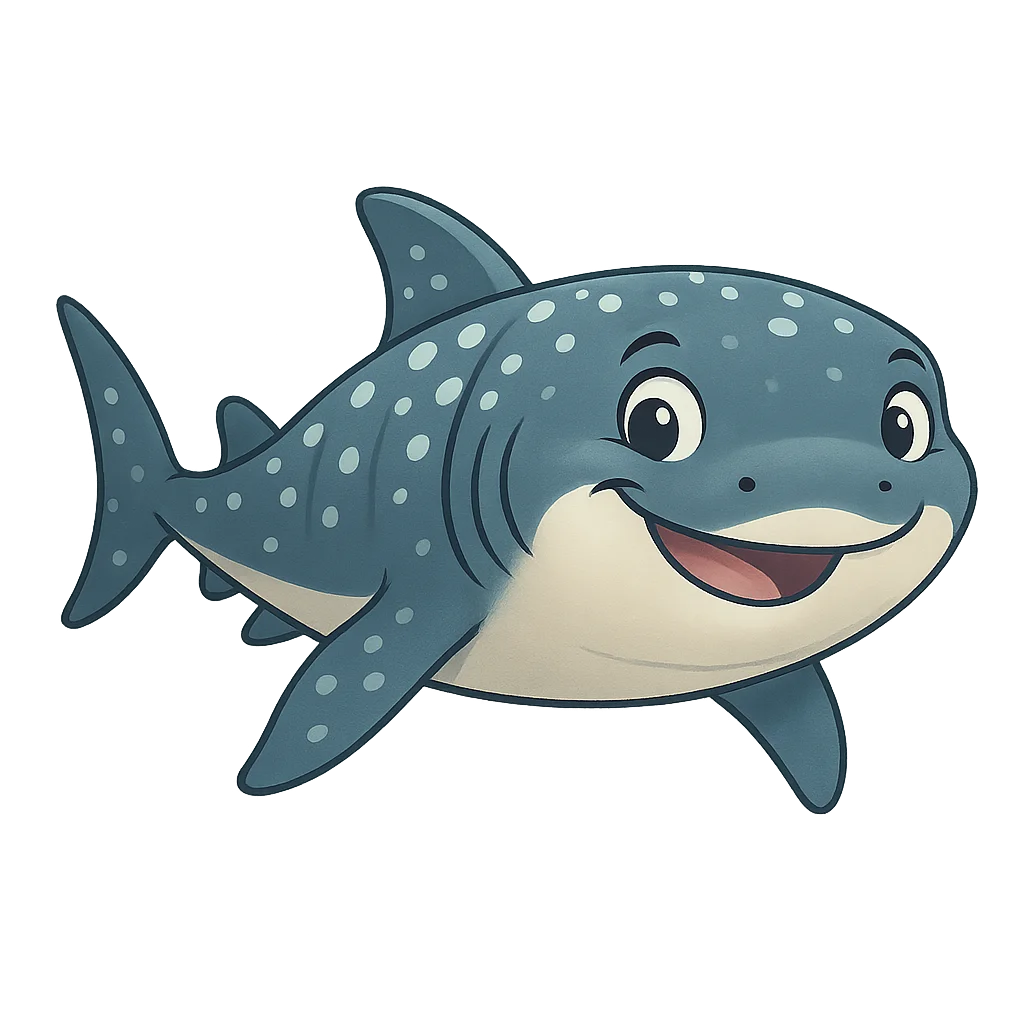
A Whale Shark's Tale: The Gentle Giant of the Sea
Hello. I am a Whale Shark, and though my name might sound a bit confusing, I am the largest fish in the entire ocean. My back is a beautiful, deep blue-gray canvas, scattered with a unique pattern of pale spots and stripes that look just like a starry night sky. This pattern is special to each one of us, like a fingerprint. I can grow to be enormous, and my mouth is incredibly wide, but it holds only tiny teeth. Don't let my name fool you; I am not a whale. Whales are mammals that need to surface for air, but I am a type of shark, which means I breathe underwater using my gills. My kind has been swimming through the world’s warm oceans for a very long time, but we were first officially described by scientists on April 18th, 1828. On that day, one of my ancestors was found in the waters of Table Bay, South Africa, introducing my species to the scientific world and beginning a long journey of human fascination with us gentle giants.
Because I am the biggest fish in the sea, you might expect me to hunt for the biggest prey. However, I prefer what I like to call the ocean’s tiniest buffet. My diet consists of some of the smallest creatures imaginable, like plankton, tiny shrimp-like animals called krill, and fish eggs. To eat, I am what is known as a 'filter-feeder.' I have two main techniques for gathering my food. Sometimes, I use a method called 'ram feeding,' where I simply swim forward with my mouth open, pushing enormous amounts of water and food into it. Other times, I use 'suction feeding,' where I stay still, open my mouth wide, and gulp in a huge volume of water like a vacuum. It might seem like I would swallow a lot of water with my food, but I have a special system to handle that. Inside my gills are structures called gill rakers. These act like a giant sieve, trapping all the delicious, tiny food particles while allowing the water to flow back out into the ocean. This way, I get all the nutrients I need from the smallest life in the sea.
I am a world traveler at heart. My life is one long journey, as I am a highly migratory species. I swim for thousands of kilometers across the vast, open oceans, following the currents and the seasons. My friends and I often gather in specific places around the world that are famous for their abundance of food. You might find large groups of us at Ningaloo Reef in Australia or in the warm waters off the coast of Mexico. We travel to these spots for what you could call food festivals. For example, we arrive when the coral are spawning, releasing clouds of eggs into the water, or when schools of tuna are doing the same. It is a feast that is worth swimming halfway across the world for. For a long time, humans did not know just how far we roamed. But starting in the late 1990s, scientists began to unlock the secrets of our travels by using satellite tags. By attaching these devices to us, they could follow my journeys and create maps of my incredible migrations across the globe, revealing the true scale of my life as an oceanic wanderer.
My family life and how I grew up are also quite special. We are 'ovoviviparous,' which is a scientific way of saying that my mother carried her eggs inside her body. Instead of laying them in the ocean, she kept them safe with her until they hatched, and then she gave birth to live pups. This meant that from the moment I was born, I was a tiny, fully-formed version of my parents, ready to swim and fend for myself. For a long time, how we had our young was a mystery. But in July of 1996, scientists made an incredible discovery when they examined a pregnant female. They learned that a single mother whale shark can carry over 300 pups at one time. We take our time growing up; we grow very slowly and do not become adults until we are about 30 years old. But our slow and steady approach to life allows us to live for a very long time, with some of us reaching up to 100 years old.
My long journey as the ocean's largest fish is a vital part of the marine world, but it is a life that faces modern challenges. My large size and slow speed make me vulnerable to dangers like accidental boat strikes and getting tangled in large fishing nets that I cannot easily escape. Because of these threats, my species was officially listed as Endangered in 2016. This special status was a declaration by humans that we needed help and protection to survive for generations to come. But my story is not one of sadness; it is one of hope and connection. My gentle nature inspires people around the world to learn more about the ocean and its incredible inhabitants. Responsible tourism, where people can see us respectfully in our natural habitat, helps provide support for both our protection and for local communities. I am a living symbol of a healthy, thriving ocean. My existence connects the smallest plankton to the largest fish, reminding everyone that every creature, big and small, has an important role to play in the great, blue world.
Activities
Take a Quiz
Test what you learned with a fun quiz!
Get creative with colors!
Print a coloring book page of this topic.




 Free for Educators