The Grand Canyon: A Story Carved in Stone
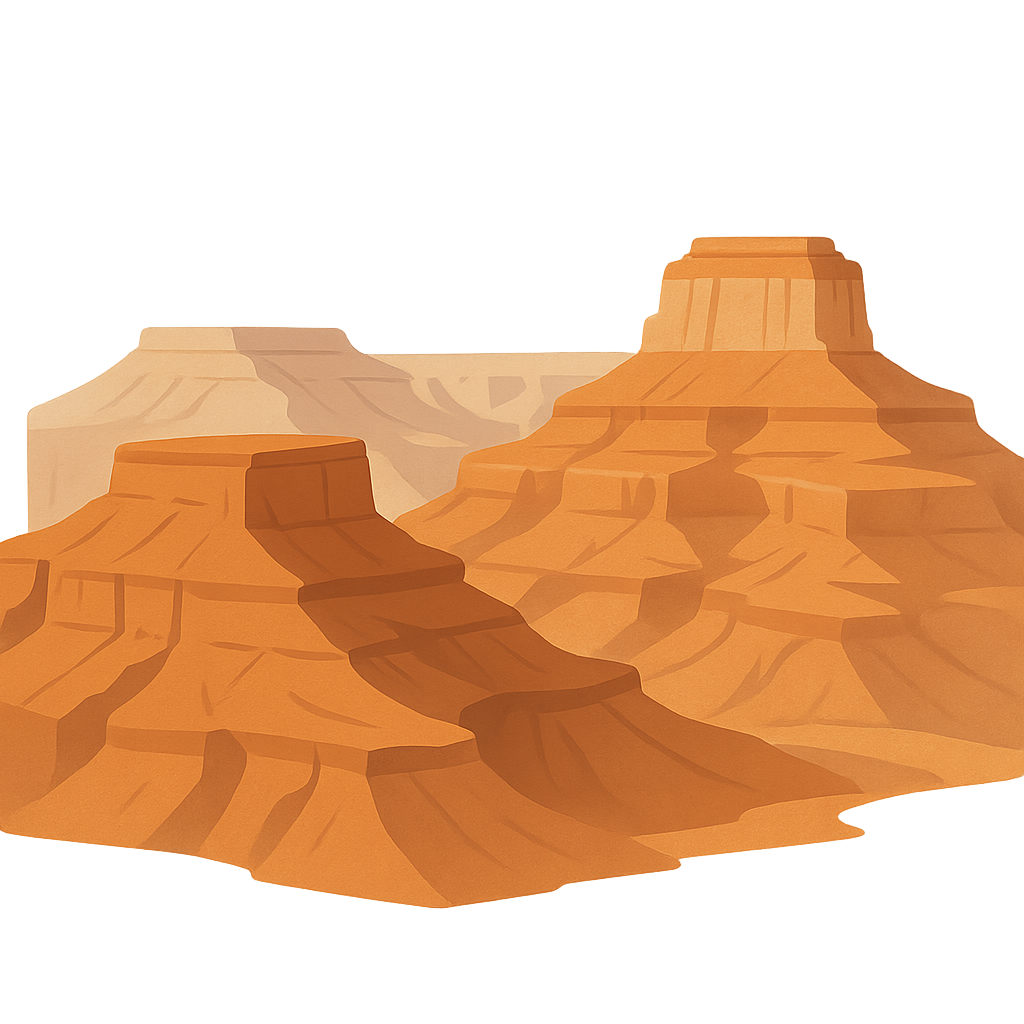
I am a giant staircase for the sun, a massive crack in the earth painted with stripes of red, orange, and purple. When morning comes, light spills down my walls, layer by layer, waking up the shadows. Deep inside, a powerful river whispers and roars, its voice echoing off my ancient stone. It has been telling stories for millions of years, a secret shared between water and rock. Eagles soar high above, looking down on a landscape so vast it can feel like another planet. People stand on my edges, looking small against my immense size, feeling a sense of wonder that quiets their minds and opens their hearts. They are looking at a story that is older than any words. I am the Grand Canyon.
My creation was a slow and patient dance between water and time. It all began about six million years ago, when the Colorado River started its long journey. Imagine a tiny artist with a tiny chisel, slowly carving a giant sculpture, day after day, year after year. That artist was the river, and its chisel was the water, sand, and pebbles it carried. The river wasn't in a hurry. For millions of years, it sliced deeper and deeper into the land, cutting through layers of rock like a knife through a colorful cake. Each layer of rock tells a different part of Earth's story. The reddish rocks speak of ancient deserts, while the gray ones tell of long-vanished seas. The oldest rocks, at my very bottom, are nearly two billion years old. I am like a giant history book with pages made of stone, and the river is still turning the pages today, carving me just a little bit deeper with every passing moment.
Long before explorers and tourists arrived, I was a home. For thousands of years, people have lived within my walls, their lives connected to my seasons and my spirit. Over a thousand years ago, the Ancestral Puebloans built their homes right into my cliffs, some of which you can still see today. They farmed in the flat areas and found shelter in my rocky overhangs. I was their fortress and their garden. Today, I am still a sacred and deeply important place for many Native American tribes. The Havasupai people, whose name means “people of the blue-green water,” live deep inside one of my side canyons, their village a hidden jewel. For the Hopi, Hualapai, and Navajo peoples, I am a part of their ancestral lands, a place for ceremony, and a reminder of their connection to the earth. I am not just a place of beauty, but a living, breathing cultural home.
For a long time, my existence was a secret known only to the people who lived here. But then, new visitors began to arrive. In the year 1540, a group of Spanish explorers led by García López de Cárdenas became the first Europeans to see me. They stood at my rim, speechless at my size, but my steep, crumbling walls defeated them. They tried for days but could not find a way to get down to the river shimmering so far below. It wasn't until 1869 that someone truly explored my inner secrets. A brave one-armed explorer named John Wesley Powell and his team of nine men climbed into small wooden boats and launched into the Colorado River. For three months, they faced dangerous rapids and unknown challenges, becoming the first to travel my entire length. They mapped my twists and turns, sharing my story with the world.
Because of my incredible beauty and scientific importance, people knew I needed to be protected. President Theodore Roosevelt visited in 1903 and declared, “Leave it as it is. You cannot improve on it.” His words helped inspire a movement to keep me safe. Finally, in 1919, I was officially named a National Park, a treasure to be preserved for everyone, forever. Today, I am a place of wonder that teaches us about the Earth's long story, the power of patience, and the stunning beauty of nature. I invite everyone to come listen to my silence, watch my colors change with the sun, and feel connected to something ancient and grand.
Reading Comprehension Questions
Click to see answer