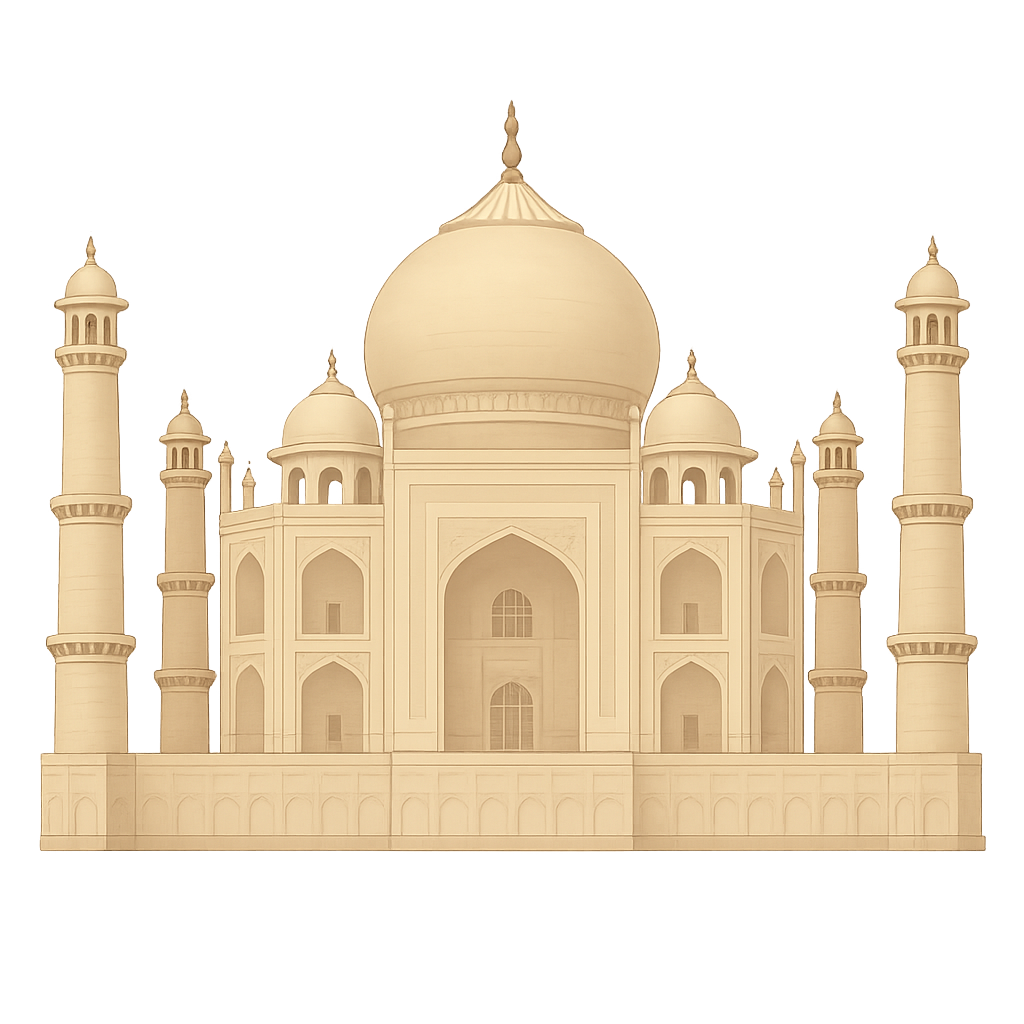
The Marble Dream
I awaken each day to the gentle touch of the morning sun on my domes. I stand on the banks of the Yamuna River in Agra, India, a vision carved from pure, white marble. As dawn breaks, my walls blush with a soft pink glow, as if I am still dreaming of the love that brought me into being. My reflection shimmers in the long, still pools of water that stretch out before me, a perfect mirror image that makes me feel as if I am floating between the earth and the sky. Visitors walk along these pools, their footsteps quiet and respectful. When they reach me, they often run their hands over my cool walls, tracing the intricate floral patterns carved into the stone. They marvel at the precious gems—lapis lazuli, jade, and turquoise—that form delicate vines and blossoms across my surface. I am a building of perfect balance, with four slender minarets standing guard at my corners, pointing toward the heavens. For centuries, people have come here not just to look, but to feel a sense of peace and wonder. They come to hear the story whispered by the wind that weaves through my archways. I am a poem written in stone, a testament to a love that time could not erase. I am the Taj Mahal.
My story begins not with triumph, but with sorrow. I am not a palace for the living, but a mausoleum—a final, beautiful resting place built to honor an eternal love. My creator was the great Mughal emperor, Shah Jahan, who ruled a vast and wealthy empire in the 17th century. His world was filled with power and riches, but his greatest treasure was his wife, the Empress Mumtaz Mahal. She was his confidante, his advisor, and the love of his life. But in the year 1631, a great sadness fell over the empire. Mumtaz Mahal passed away, leaving the emperor utterly heartbroken. In his grief, Shah Jahan made a promise to her: he would build a tomb so magnificent and beautiful that the world would never forget her name or their love. He vowed it would be a paradise on Earth, a jewel unlike any other. The very next year, in 1632, the emperor’s promise began to take shape. It was a monumental undertaking, an act of devotion on an unimaginable scale. More than 20,000 artisans were summoned from across the Mughal Empire and Central Asia. Stonecutters, masons, calligraphers, and gem-setters all brought their skills to my creation. A brilliant architect, Ustad Ahmed Lahori, is believed to have been the one who guided this grand design, ensuring every detail was flawless. The emperor spared no expense. He sent for the finest materials the world had to offer. Enormous blocks of translucent white marble were hauled by over 1,000 elephants from the quarries of Rajasthan, more than 200 miles away. Jade and crystal were brought from China, shimmering turquoise from Tibet, deep blue lapis lazuli from Afghanistan, and sapphires from Sri Lanka. For over two decades, the air buzzed with the sounds of chisels and hammers. Slowly, meticulously, I rose from the ground. My central dome, a perfect marble tear-drop, was carefully constructed to be both massive and weightless. The four minarets surrounding me were designed to lean slightly outward, so that in the event of an earthquake, they would fall away from the main tomb, protecting the queen's final resting place. Every surface was adorned with incredible artistry, from the flowing Arabic calligraphy that spells out verses from the Quran to the delicate marble screens, carved so finely they look like lace. Finally, around the year 1653, the work was complete. I stood finished, a gleaming white monument to a love that had reshaped the landscape itself. Shah Jahan had kept his promise. He had created a masterpiece, and inside my central chamber, beneath the grand dome, lay the tomb of his beloved Mumtaz Mahal, forever enshrined in beauty.
For nearly four hundred years, I have watched the world change from my place on the riverbank. I have seen empires rise and fall, and I have felt the passing of countless seasons. My appearance shifts with the light of each day, a constant, gentle performance for all who see me. At sunrise, I am draped in hues of soft pink and lilac. Under the brilliant midday sun, my white marble dazzles so brightly it almost hurts the eyes. And in the quiet of the evening, under the glow of the moon, I become a pearly, ethereal silhouette. My endurance and timeless beauty have not gone unnoticed by the modern world. In 1983, I was named a UNESCO World Heritage site, a title that recognizes me as a treasure belonging to all of humanity. It is a promise to protect me for generations to come. Today, millions of visitors from every corner of the globe walk through my grand gates each year. They come from different cultures and speak different languages, but they all stand before me with a shared sense of awe. They come not just to admire my architecture, but to connect with the powerful story I hold within my walls. I am more than just a building; I am a reminder that the most beautiful and lasting things are often born from love. My existence proves that through creativity and devotion, humans can create something that connects us all across the centuries, whispering a timeless story of love to the entire world.
Reading Comprehension Questions
Click to see answer