The Stone City in the Clouds
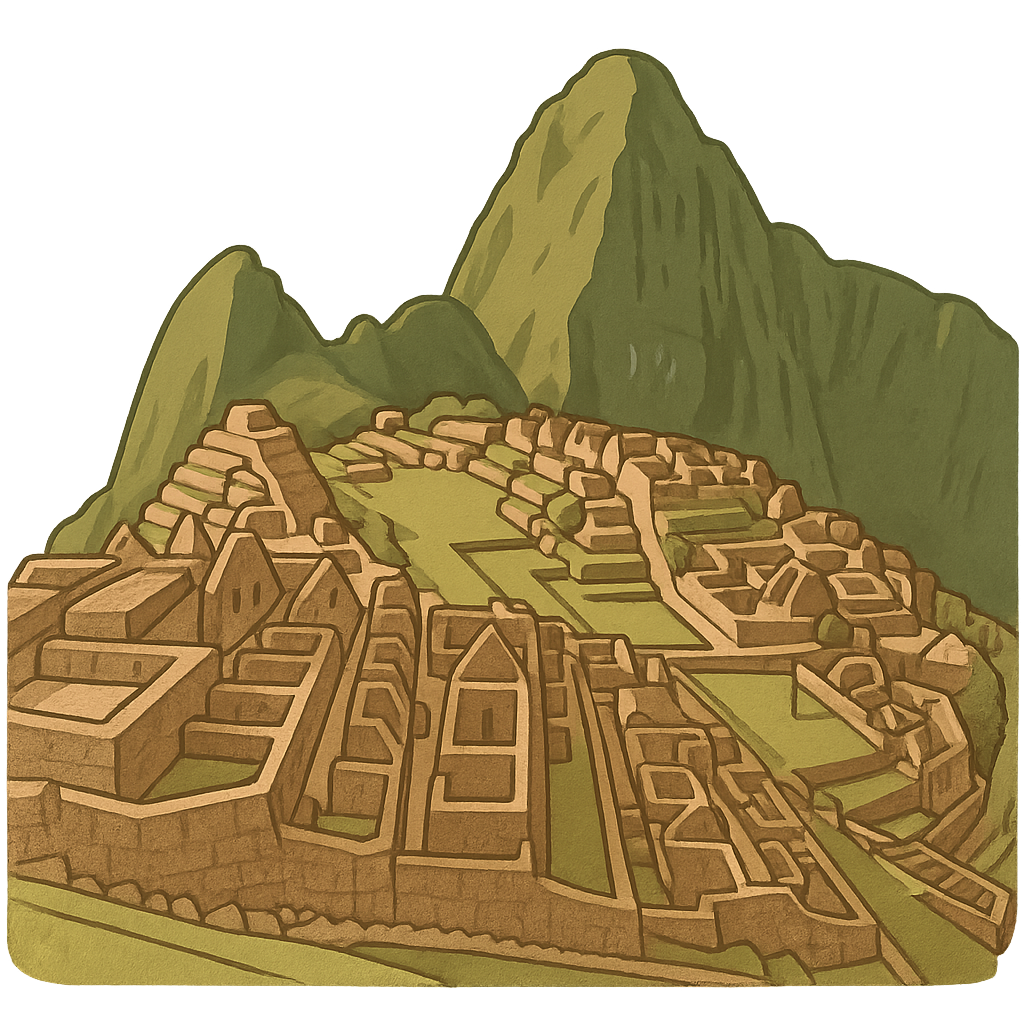
I awaken each morning to a blanket of cool, white mist that drifts through my stone doorways and settles upon my green terraces. From my perch, nearly 8,000 feet high in the Andes Mountains of Peru, I watch the world below sleep. The sun, my oldest friend, slowly climbs over the jagged green peaks, its golden rays chasing the shadows away and warming my granite walls. Alpacas and llamas, with their soft footsteps, wander freely along my pathways, nibbling at the grass that grows between my perfectly fitted stones. For centuries, I have listened to the whisper of the wind and the roar of the Urubamba River in the valley far below. I am a city of silence and secrets, a puzzle carved into a mountain ridge. I am a testament to a people who understood the sky, the stone, and the sacred earth. I am Machu Picchu.
My story begins in a time of great power and vision, around the year 1450. The world knew my creators as the Inca, the children of the sun god, Inti. Their empire was vast and mighty, and at its head was a brilliant emperor named Pachacuti. It was he who looked upon this mountain saddle and envisioned a sanctuary, a royal estate far from the bustle of the capital city of Cusco. His architects and engineers were masters of their craft. They commanded thousands of workers to shape the very mountain. They did not use mortar or cement to hold me together. Instead, they practiced a technique called ashlar, cutting and sanding enormous granite blocks with such precision that they fit together like pieces of a giant jigsaw puzzle. To this day, you cannot slip a knife blade between my stones. They built me with purpose: temples like the Torreón to track the sun’s journey, royal residences for the emperor, homes for priests and nobles, and vast agricultural terraces that cascade down the mountainside to grow maize and potatoes.
My life as a bustling estate, however, was destined to be short. For about a century, I was filled with ceremony, work, and life. But in the 1530s, the Inca Empire faced a challenge it could not overcome. Spanish conquistadors arrived in their lands, bringing with them new weapons and unfamiliar diseases. The empire fell, and its people scattered. Because I was built in such a secret, remote place, the invaders never found me. My residents slowly departed, and I began a long, quiet sleep. The jungle, patient and persistent, crept back over my walls. Vines snaked through my windows, and trees took root in my plazas. But I was never truly lost. The local Quechua people, descendants of the Inca, always knew I was here. They called me the 'old peak' and sometimes planted crops on my terraces, their presence a quiet promise that I would not be forgotten.
For nearly 400 years, I slumbered, known only to a few. Then, in the year 1911, the world’s attention turned back to me. An American historian and explorer from Yale University named Hiram Bingham III was trekking through these mountains. He was searching for Vilcabamba, the legendary last capital of the Inca resistance. He heard whispers from local farmers of magnificent ruins hidden on a mountaintop. A local farmer named Melchor Arteaga agreed to guide him, and on a misty morning, Arteaga’s young son led Bingham up my steep slopes. Imagine his astonishment when he emerged from the dense forest to see my stone structures standing proud against the sky. He and his team spent months carefully clearing away the jungle’s embrace, revealing my temples, houses, and fountains. It was not a discovery, for I was never lost to the people of this land. It was an introduction, a moment when my story was shared with the rest of the world.
Today, my voice speaks to thousands of visitors who make the journey to see me. I am a UNESCO World Heritage site, a treasure protected for all of humanity. People walk my ancient paths and feel a connection to the brilliant civilization that built me. They marvel at the ingenuity of my construction and the harmony I share with the breathtaking nature around me. I am no longer a home for an emperor, but a home for memory and wonder. I stand as a bridge between a magnificent past and an ever-changing present, reminding everyone of the incredible things humans can achieve. My story is a lesson in resilience, a whisper from the past that inspires us to protect the beautiful and sacred places of our world for generations to come.
Reading Comprehension Questions
Click to see answer