The Sacred Rock of Athens
I feel the warm Greek sun on my ancient, rocky skin. Below me, the city of Athens hums with the energy of cars, conversations, and commerce—a modern world I have watched grow for thousands of years. The wind whispers secrets through my broken columns, carrying the scent of olive trees and city smog. For millennia, I have been the silent witness perched high above this land. I have seen philosophers in simple robes walk my paths, debating the meaning of justice and truth. I have watched processions of citizens climb my slopes to honor the gods, their voices echoing in joyful chorus. I remember the glint of bronze shields and the hushed prayers of soldiers before battle. Now, I see visitors from every corner of the earth, their faces filled with wonder as they gaze upon my weathered marble. They try to imagine the world I once knew, a world of myth and might. I am a stage where history was written, a fortress of faith, and a beacon of ideas that changed the world. I am the Acropolis, the Sacred Rock of Athens.
My story is one of rising from ashes. Long before my famous temples stood, I was a natural fortress, a high and defensible hill where early kings built their palaces. My slopes were a sanctuary, a place where people felt close to the gods. But my peace was shattered in the year 480 BCE. An invading army from the Persian Empire swept through Greece, and when they reached Athens, they climbed my sides and showed no mercy. They burned my old temples, toppled my statues, and left me a blackened, smoldering ruin. For a generation, I remained a scar, a painful reminder of the cost of war. But Athenians are resilient. After they bravely drove the invaders away, a new leader emerged named Pericles. He was a brilliant statesman with a vision that soared as high as my peak. He looked at my ruins and did not see an end, but a magnificent new beginning. He declared that we would rebuild, not just to replace what was lost, but to create a symbol of Athenian democracy, power, and cultural brilliance that the world would never forget. My reconstruction was to be an act of defiance and a monument to hope.
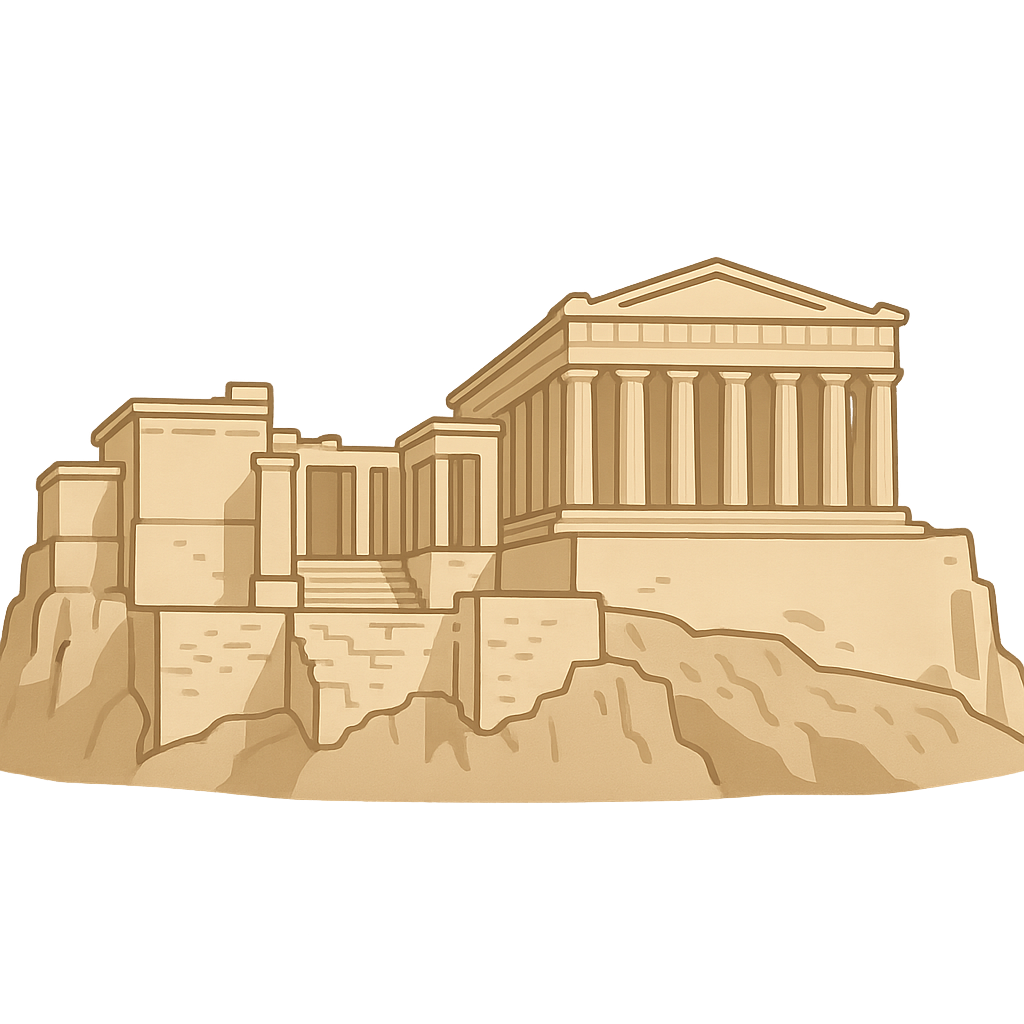
Around 447 BCE, my transformation began, and I became the busiest place in the ancient world. The air filled with the rhythmic clang of hammers on chisels and the shouts of foremen directing thousands of skilled artisans. Great blocks of gleaming white marble, pulled from a nearby mountain, were hauled up my steep slopes by oxen and complex systems of ropes and pulleys. This was the Golden Age of Athens, a time of unparalleled creativity, and Pericles had gathered the greatest minds to oversee my rebirth. The brilliant architects Ictinus and Callicrates designed my centerpiece, a temple of perfect proportions and breathtaking beauty: the Parthenon. It was dedicated to the city’s patron, Athena Parthenos, the goddess of wisdom and warfare. To manage the entire artistic program, Pericles chose the master sculptor Phidias, perhaps the greatest artist of his time. Inside the Parthenon, Phidias created a colossal statue of Athena that stood nearly 40 feet tall. She was crafted from a wooden core covered in shimmering gold and smooth ivory, holding a statue of Nike, the goddess of victory, in her palm. But the Parthenon was not my only jewel. Visitors would first pass through the Propylaea, a majestic gateway of towering columns. They would see the elegant Erechtheion, a sacred temple with its famous porch held up by six beautiful statues of maidens known as the Caryatids. And nearby stood the small, perfect Temple of Athena Nike, a celebration of the victories that had made this golden age possible.
My Golden Age could not last forever, and the centuries that followed brought constant change. I have been a fortress for Roman governors, a Christian church dedicated to the Virgin Mary, and later, under the Ottoman Empire, the Parthenon served as a mosque, with a tall minaret added to its side. I have seen empires rise and fall from my vantage point, each leaving its mark on me. I have also suffered greatly. My deepest wound came in 1687, during a war between the Venetians and the Ottomans. The Parthenon was being used as a gunpowder store when a Venetian cannonball struck it, causing a catastrophic explosion that blew out its center and sent its magnificent sculptures crashing to the ground. Yet, I endured. My brokenness became part of my story, a testament to the turbulent history I have witnessed. Today, I am cherished and protected as a UNESCO World Heritage site. Archaeologists and conservators work tirelessly to preserve my fragile marble, studying my secrets and piecing together my past. People from all over the world still climb my slopes, not for war or worship, but for connection and inspiration. They come to walk in the footsteps of history and to feel the power of the ideas—democracy, beauty, and human potential—that were brought to life right here. I am more than a ruin; I am a living reminder that what humans create with vision and hope can echo through eternity.
Reading Comprehension Questions
Click to see answer