The Flight of Icarus
I am a whisper on the wind, a longing for the open sky. Before I was a story written in books, I was a feeling in the human heart. Imagine standing in a high tower on a sun-drenched island, the salty air warm on your face. Below you, the Aegean Sea glitters like a carpet of crushed sapphires. Far above, eagles and gulls soar on invisible currents, masters of a world without walls. That feeling you have, watching them—that deep, aching desire to join them, to break free from everything that holds you down—that is where I begin. I am that universal dream of flight. I am the tale of a father's unmatched genius, a son's boundless joy, and a journey that dared to touch the heavens. I am the story of Icarus, and my flight began long ago, when the world was new and the gods still walked among mortals.
My story was first told on the island of Crete, a kingdom of immense power in Ancient Greece. The Greeks were brilliant people, fascinated by heroes, monsters, and the incredible power of the human mind. It was here that the master inventor, Daedalus, and his young son, Icarus, were held captive. Daedalus was the greatest craftsman of his age, a man who could build statues that seemed to breathe and machines that defied logic. The formidable King Minos had commissioned him to build a Labyrinth, an intricate maze from which no one could escape, to imprison the fearsome Minotaur. Daedalus built it so perfectly that he himself was the only one who knew its secrets. Fearing that this knowledge could be used against him, King Minos made the entire island their prison. Though Crete was beautiful, with its olive groves and sparkling shores, it was a cage. Every ship in the harbor was guarded, making escape by sea impossible.
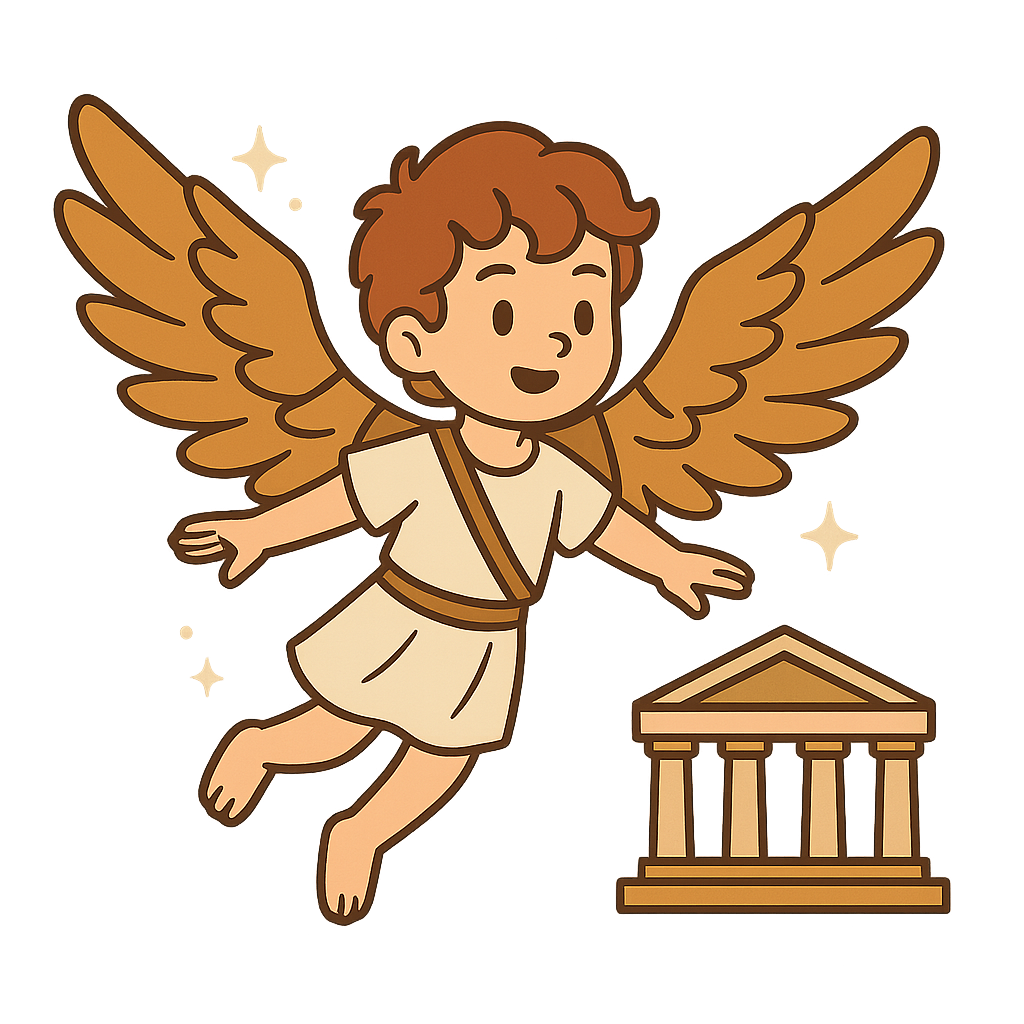
But a mind like Daedalus's could not be caged. He saw a solution where others saw only despair: the sky. 'We will escape through the air,' he told Icarus, his eyes gleaming with an idea. He began observing the birds, studying the architecture of their wings and the way they manipulated the wind. For weeks, he and Icarus gathered feathers dropped by seabirds along the cliffs. They collected every size, from the downy fluff of a sparrow to the great, sturdy quills of an eagle. In their hidden workshop, Daedalus arranged the feathers in overlapping arcs, mimicking a bird's wing. He showed Icarus how to bind the smaller feathers with linen thread and then meticulously set the larger ones in beeswax. It was a marvel of engineering, turning simple, discarded things into a miracle. Before they took flight, Daedalus fitted the wings on his son and gave him a loving but solemn warning. 'Icarus,' he said, his voice firm, 'we must fly the middle path. Too low, and the sea's damp mist will clog your wings. Too high, and the sun's fervent heat will melt the wax. Follow me closely, and do not stray.'
That first moment of liftoff was pure magic. A running start, a powerful flap, and suddenly the ground fell away. The wind roared in my ears, a symphony of freedom. For Icarus, it was a sensation beyond his wildest dreams. The world, which had been his prison, now unfolded below him like a map. The grand palace of Knossos looked like a child's toy, and the people on the shore were no bigger than ants. He laughed, a sound of pure, unadulterated joy that was snatched away by the wind. He tilted his wings, swooping and climbing, feeling more alive than ever before. In this moment of exhilaration, his father’s cautious words faded into a distant echo. Why follow when he could lead? Why stay in the middle path when the heavens beckoned? He felt invincible, a god of the sky. He wanted to feel the sun's golden warmth, to fly where no human had ever flown. As he climbed, the air grew warmer. A pleasant scent, like honey, drifted up from his shoulders. It was the smell of the melting wax. A single, small feather detached and spiraled down. Then another. He barely noticed, so consumed was he by his ambition. His wing beats became less effective, the flight more frantic, until the magnificent wings finally disintegrated, and he began his long, silent fall back to the sea.
For the Ancient Greeks who first told my story, I was a powerful lesson about the dangers of 'hubris'—a word they used for pride so excessive that it makes you reckless and defiant of limitations. I was a cautionary tale that taught them to respect the wisdom of their elders and to understand that ambition without discipline can lead to ruin. But my journey didn't end there. I flew through the centuries, carried in the words of poets and the brushes of painters. The great artist Pieter Bruegel captured the moment of my fall in a famous painting, showing a world that barely notices the tragedy, a reminder that life moves on. My name, Icarus, became a symbol for every brilliant dreamer who dares to fly too high, a shorthand for glorious, tragic failure. Yet, I am also present in the spirit of every success. I was there in the dreams of the Wright brothers as they designed their first airplane and in the calculations of the engineers who sent astronauts to the moon. I remind humanity that reaching for the stars requires not just daring courage, but also meticulous planning and respect for the powerful forces you seek to master.
So you see, I am more than just a story of a boy who fell from the sky. I am the story of the courage it takes to even try to fly. My spirit lives on in every inventor who builds a new machine, every artist who creates something beautiful, and every dreamer who looks at the world and imagines how it could be better. I represent the delicate, beautiful balance between our wildest ambitions and the wisdom that keeps us grounded enough to achieve them. So when you look up at the sky, remember me. Let your imagination take flight, dare to dream of your own sun, and chase it with all your heart. But as you do, remember to build your wings with care, to listen to the voices of wisdom that guide you, and to respect the journey as much as the destination.
Reading Comprehension Questions
Click to see answer