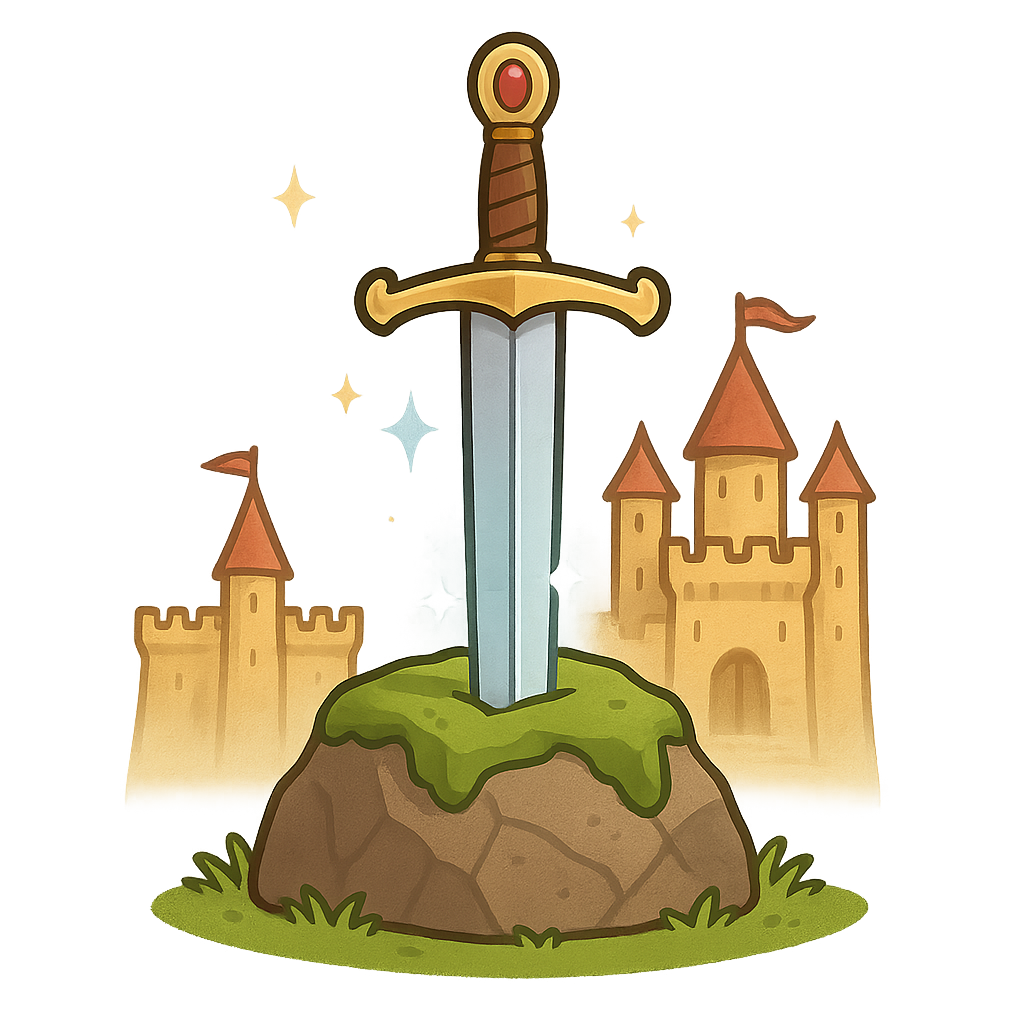
The Sword, The Stone, and The Legend
Before I had a name, I was just a feeling—a whisper on the wind across a land shrouded in mist. This place, ancient Britain, was a patchwork of feuding kingdoms, a land of deep forests and rugged hills that longed for a leader to unite its people. You could feel the world holding its breath, waiting for a hero. In the heart of London, in a quiet churchyard, a great stone sat with an anvil fixed upon it. Thrust deep into the anvil was a magnificent sword with gold letters on its blade that promised a kingdom to whoever could pull it free. For years, the strongest dukes and the most ambitious knights had tried. They heaved and strained, their muscles bulging and their faces red with effort, but the sword would not budge. It was a test not of strength, but of something more, something the world had almost forgotten. The land waited, the sword waited, and I took shape in the songs of bards and the hopes of the common folk. I am the story of a boy who became a king, a fellowship that became a legend. I am the tale of King Arthur and the Knights of the Round Table.
My true beginning sparked into life with a boy named Arthur. He was young and humble, serving as a squire to his older brother, Sir Kay. He had no grand ambitions for himself, only a desire to do what was right. One day, when Kay forgot his sword for a tournament, Arthur rushed off to find him one. He saw the sword in the churchyard stone, and thinking it was simply a war memorial, he gave it a gentle pull. It slid out as easily as if from water. He hadn't used brute force, but an honest heart and a pure spirit. That simple act revealed him as the chosen one, the trueborn king. Of course, the powerful lords were skeptical. How could this unknown boy be their ruler? This is where the wise and mysterious wizard, Merlin, stepped in. He had watched over Arthur his whole life, knowing the boy’s destiny. Merlin, with his deep knowledge of magic and human nature, became Arthur’s guide and most trusted advisor. He helped Arthur prove his worth and claim his throne. Together, they built the shining castle of Camelot, a beacon of hope and justice. At its heart, they placed the famous Round Table. Merlin designed it to be a powerful symbol: it was round so that every knight who sat there was equal. No one was at the head of the table because their voices all mattered the same. The greatest knights in the land were drawn to this vision, like the fiercely brave Sir Lancelot and the pure-hearted Sir Galahad. They all swore an oath to live by the code of chivalry—a promise to be courageous, just, and to protect those who could not protect themselves.
Life in Camelot was filled with purpose. The knights didn’t just sit around polishing their armor; they embarked on thrilling adventures to uphold their vows. They fought rogue giants, stood against unjust rulers, and rescued people in distress. But their greatest and most challenging mission was the quest for the Holy Grail. This was said to be the cup used at the Last Supper, and it was thought to hold miraculous powers. But this was no ordinary treasure hunt. Finding the Grail was a test of the soul. Only the most virtuous, noble, and spiritually pure knight could succeed. This epic journey scattered the knights across enchanted forests and into immense dangers, testing their loyalty to one another and to their king. It forced each one to confront their own flaws and prove their worthiness. For centuries, I was a story told not in a single book, but shared through songs and poems by Celtic bards in places like Wales and Britain. These storytellers would travel from court to court, keeping my memory alive. It was much later that writers like Geoffrey of Monmouth in Wales and, most famously, Sir Thomas Malory in England, gathered all my scattered threads. They wove my adventures, my triumphs, and my tragedies into the grand tale that is known around the world today.
A legend like me mattered so much to people, especially during the Middle Ages, because I offered a vision of a better world. In an era of constant conflict and hardship, I gave them Camelot—an image of a perfect kingdom built on honor, justice, and courage. It was something to aspire to. I showed them what true leadership could look like: not a king who ruled through fear, but one who inspired loyalty through fairness and led a fellowship of equals. Even though the golden age of Camelot eventually came to an end, the ideas I stand for are timeless. The quest for fairness, the courage to do what is right, and the importance of friendship and equality are adventures we can all still embark on in our own lives. I am more than just an old story; I live on in books, movies, and games, constantly retold and reimagined. I am here to remind everyone that the spirit of the Round Table—where everyone has a voice and works together for a greater good—is not just a myth. It is a story that belongs to us all, a legend that never truly ends.
Reading Comprehension Questions
Click to see answer