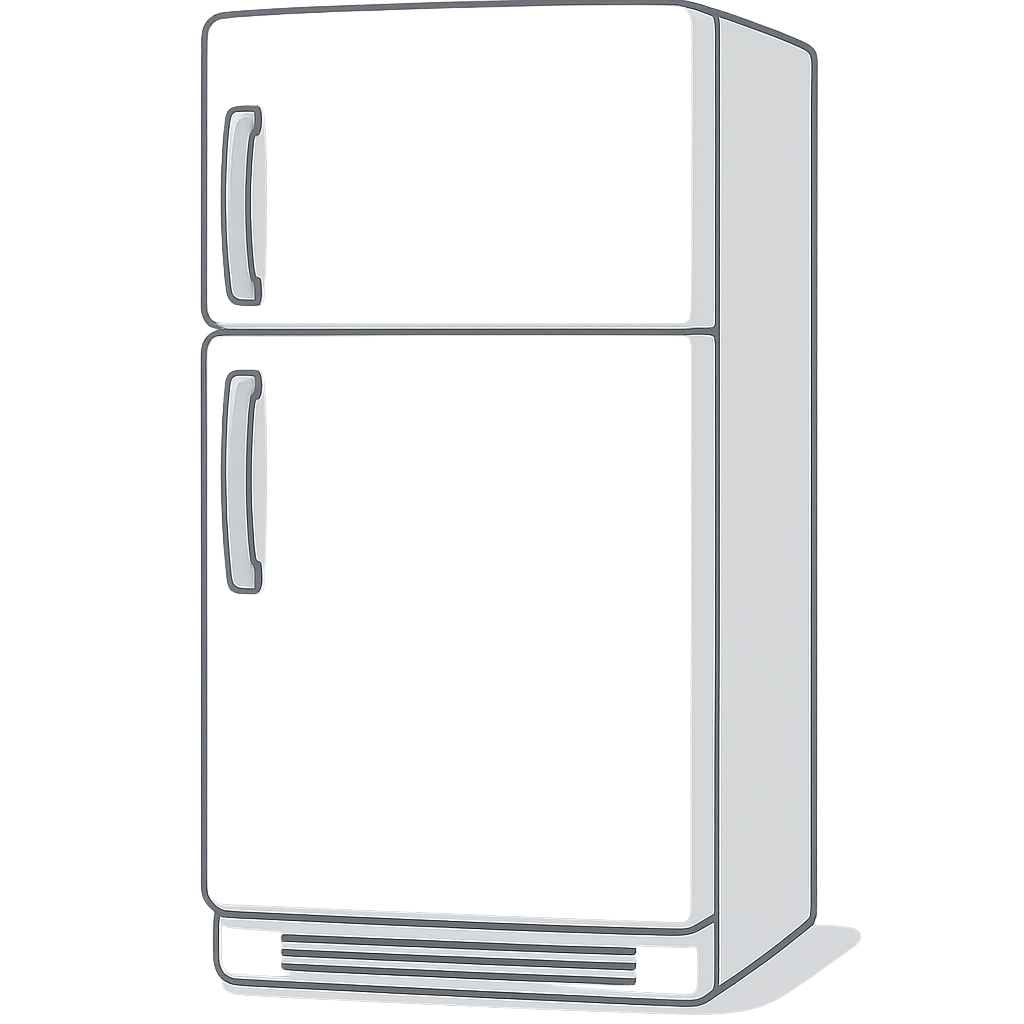
The Keeper of Cool: My Life as a Refrigerator
Hello there. You probably know me. I’m the one humming quietly in your kitchen, keeping the milk cold and the popsicles frozen. But have you ever wondered what the world was like before I arrived? Imagine a sweltering summer day, long before the year 1900. Your family would have relied on a simple wooden cabinet called an icebox. A big block of ice, delivered by an iceman, would be placed inside to keep things cool, but only for a little while. The ice would melt, leaving a puddle that had to be emptied, and food still spoiled quickly. Families had to shop for groceries almost every day. Fresh milk was a luxury that might not last until evening, and meat had to be cooked and eaten immediately. People used root cellars, cool and damp underground rooms, to store potatoes and apples, but it was a constant battle against time and decay. The world was waiting for a better, more reliable way to stay cool, and that’s where my story begins.
My existence is thanks to centuries of human curiosity. For a long time, making things cold without ice was just a scientific curiosity. As early as 1756, a Scottish professor named William Cullen demonstrated how evaporating liquids could create a cooling effect, but it was just a laboratory experiment. Later, in 1805, an American inventor named Oliver Evans designed a machine based on a similar idea, but he never built it. The true spark of my creation came from another American inventor, Jacob Perkins. In 1834, while living in London, he patented the machine that would become my heart: the vapor-compression cycle. It sounds complicated, but think of it like this: I have special fluid inside my veins that acts like a heat sponge. I pull the warmth out of the air inside my compartments, turning the fluid into a gas. Then, a compressor squeezes that gas, making it very hot. I release that heat out into your kitchen through the coils on my back. As the fluid cools down, it turns back into a liquid, ready to go back inside and absorb more heat. It’s a continuous cycle, a clever trick of physics that lets me keep my cool, no matter how warm it is outside. Jacob Perkins’s idea was the key that unlocked a new world of preservation.
For many decades, I was far too big and expensive for a family’s kitchen. My first real job was in large industries. A clever man named James Harrison, working in Australia in the 1850s, used my technology to create giant cooling rooms for breweries and meatpacking plants. I was a massive, clanking machine, but I was revolutionary! I helped ship fresh food across oceans for the first time. I was proud of my work, but I dreamed of being closer to people, of helping families directly. My dream started coming true in the early 20th century. An inventor from Chicago named Fred W. Wolf designed one of the first popular home models in 1913, which he called the DOMELRE. It was still a bit clunky—the cooling unit often sat on top of a regular icebox—but it was a start! Then, in 1927, the General Electric company introduced the “Monitor-Top” refrigerator. With its distinctive round compressor on top, it became an icon. More than a million of these models were sold. I had finally made it! I remember the sheer wonder on people's faces. For the first time, they could make their own ice cubes, keep leftovers for days, and enjoy a scoop of ice cream on a whim. I wasn't just a machine; I was a source of convenience, safety, and even joy.
Today, I stand as a quiet and reliable member of your household. I am more than just a cold box; I am a guardian of health, protecting your family from the bacteria that spoil food. I am a preventer of waste, helping you save money and resources by keeping your groceries fresh. I am also a keeper of delicious memories, from the birthday cake waiting for its candles to the holiday leftovers that bring a smile days later. My journey is not over. My designers are constantly making me smarter and more energy-efficient, so I can do my job while being kinder to our planet. From a simple scientific idea to the heart of the modern kitchen, I have had an amazing life. And I’ll always be here for you, ready with a cool drink and a fresh snack, humming my quiet song of progress.
Reading Comprehension Questions
Click to see answer