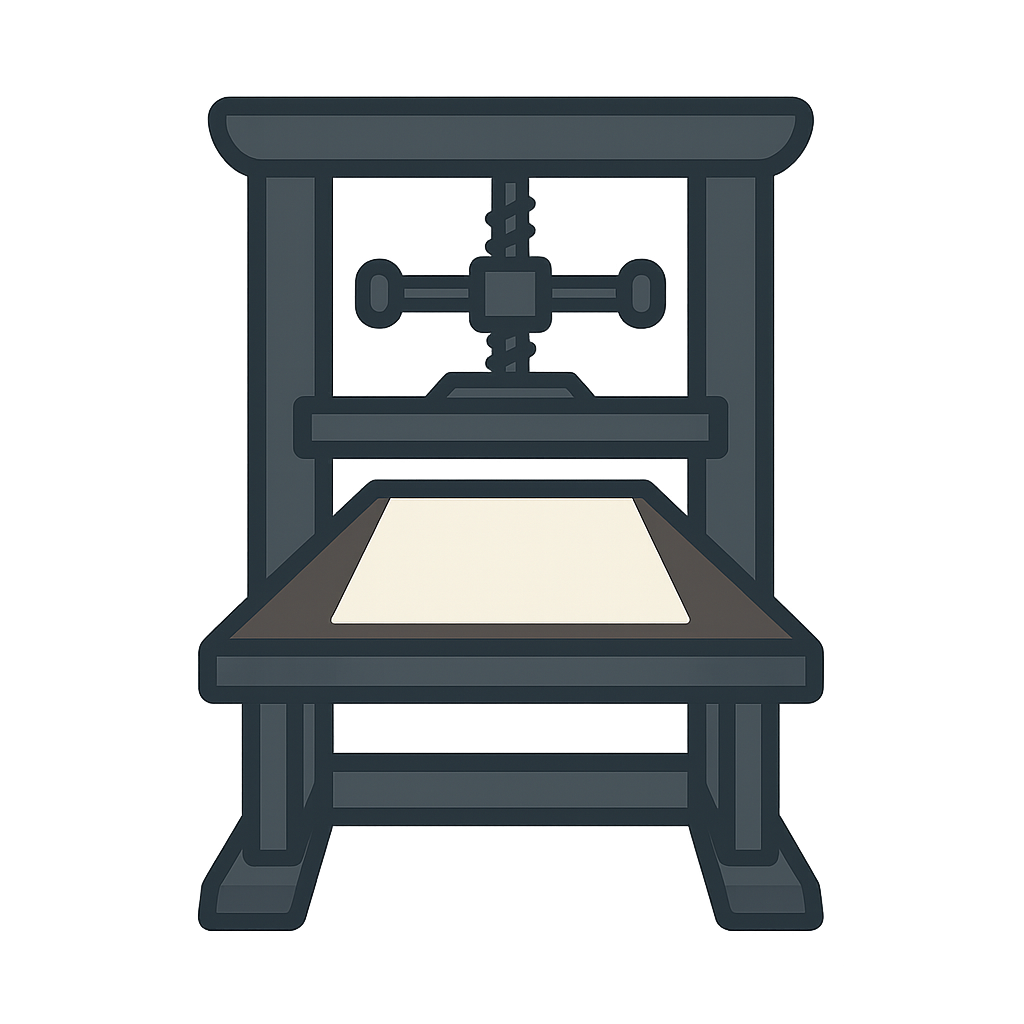
I Am the Printing Press
Before I existed, the world was a much quieter place, filled with whispers and the slow, scratching sound of quill pens on parchment. I wasn't a machine yet, just an idea simmering in the mind of my creator, Johannes Gutenberg. In the mid-1400s, books were like jewels—rare, beautiful, and owned only by the wealthiest lords, scholars, and clergymen. Each one was a work of art, copied by hand by scribes who spent months, sometimes years, recreating a single volume. An entire library might contain only a few dozen books. Gutenberg saw this and felt a deep frustration. He was a man who loved knowledge, and he believed that ideas, stories, and sacred texts were not meant to be locked away in monasteries or castles. He dreamed of a way to set them free, to let them travel from city to city, from mind to mind, as quickly as a spoken word. He imagined a world where a farmer or a merchant could own a book, and it was that powerful dream that gave me my first spark of life.
My creation began not in a scholar's study, but in a craftsman's workshop. Johannes Gutenberg was a goldsmith and metalworker in Mainz, Germany. His hands were skilled at shaping metal with precision, at casting intricate designs, and understanding the properties of different alloys. This unique background gave him the tools to solve a problem that had stumped others for centuries. Around the year 1440, his big idea began to take shape. Scribes copied one letter at a time, a slow and tiring process prone to error. But what if, he thought, each letter could be its own separate piece of durable metal? A tiny, reusable block that could be arranged to form words, then lines, then entire pages. After a page was printed, the letters—the movable type—could be sorted and used again for the next page. This was the heart of my design. For the muscle, he looked to the rolling hills of the Rhine Valley, where powerful screw presses were used to crush grapes for wine. He envisioned a similar machine, one that could apply firm, even pressure to press a sheet of paper against the inked metal letters, transferring the image perfectly every single time.
Turning that vision into reality was a long, arduous journey filled with ink-stained hands and sleepless nights. For more than a decade, Gutenberg labored in secret, terrified that someone would steal his revolutionary idea. His workshop became a laboratory of constant experimentation. The first major challenge was the type itself. What metal would be strong enough to withstand the immense pressure of the press but soft enough to be cast with precision? He tried lead, but it was too soft. He tried tin, but it was too brittle. After countless failed attempts, he finally discovered the perfect alloy of lead, tin, and antimony. Next came the ink. The watery, soot-based ink used by scribes would just run off the smooth metal letters. He needed something thick and sticky, something that would cling to the type. He developed a new, oil-based varnish ink, more like a paint, that was perfect for the job. These years of trial and error were not only difficult but also incredibly expensive. In 1450, to keep his dream from collapsing, he had to borrow a large sum of money from a wealthy businessman named Johann Fust, making him a partner in the venture. The pressure was immense, but Gutenberg's belief in me never wavered.
Finally, around the year 1455, the moment of triumph arrived. After years of relentless work, the first major book ever printed using movable type was completed: the stunningly beautiful 42-line Bible, now known as the Gutenberg Bible. Holding a page, my creator must have felt a profound sense of awe. Every letter was crisp and uniform, every line perfectly spaced. My work was not just faster; it was beautiful. That first printing of about 180 copies set in motion a change more powerful than any army. Suddenly, knowledge was no longer chained to a scribe's desk. My siblings—other printing presses built from my design—sprang up across Europe. By 1500, millions of books had been printed. Ideas about science, art, religion, and philosophy spread like wildfire, fueling the Renaissance and the Reformation. I sparked a revolution not of swords, but of words. From my simple wooden frame and metal letters grew the world of books, newspapers, and learning that you know today. Every time you read a book or even a screen, you are feeling the echo of my first press, a testament to the enduring power of one shared idea.
Reading Comprehension Questions
Click to see answer