Orville Wright and the First Flight
My name is Orville Wright, and ever since I was a boy, my brother Wilbur and I dreamed of flying. It all started one evening when our father brought home a wonderful toy. It was made of cork, bamboo, and paper, with a rubber band to make its little propellers spin. When he tossed it into the air, it didn't just fall—it fluttered up to the ceiling! We were amazed. That little toy helicopter planted a big idea in our minds: if a small toy could fly, why couldn't a person? We spent our days building kites and tinkering with anything we could find. As we grew up, we opened our own bicycle shop in Dayton, Ohio. Fixing and building bicycles might not sound like it has much to do with flying, but it taught us everything about balance and control. We learned how a slight shift in weight could change direction and how to build strong, lightweight frames. Every gear we fixed and every wheel we balanced was a small step toward our bigger dream. We didn't know it then, but our little bicycle shop was becoming the workshop where the world's first airplane would be born. The dream that started with a toy was now being built with spokes, chains, and a whole lot of hard work.
Our workshop in Dayton was always filled with the smell of sawdust and grease. It was our favorite place in the world. For years, Wilbur and I spent nearly every waking hour there, sketching designs, arguing about ideas, and building models. The biggest puzzle was the wings. How could we make them strong enough to lift a person but also able to be controlled? We watched birds for hours, noticing how they twisted the tips of their wings to steer. We called this idea 'wing-warping,' and it became the key to controlling our machine. Next, we needed an engine. All the engines for cars were far too heavy; they would have kept our machine stuck on the ground. So, we had to build our own—a small, light engine that was just powerful enough to get us airborne. The propellers were another challenge. We realized they were like wings, but spinning around to push the air. After countless calculations and carvings, we had two beautiful wooden propellers ready. But where could we test our invention? We needed a place with strong, steady winds and soft ground for a safe landing. After studying weather maps, we found the perfect spot: a little town called Kitty Hawk in North Carolina. Its sandy dunes and constant breezes were exactly what we needed. So, we packed up our machine, which we called the Wright Flyer, and headed for the coast, feeling a mix of excitement and nervousness.
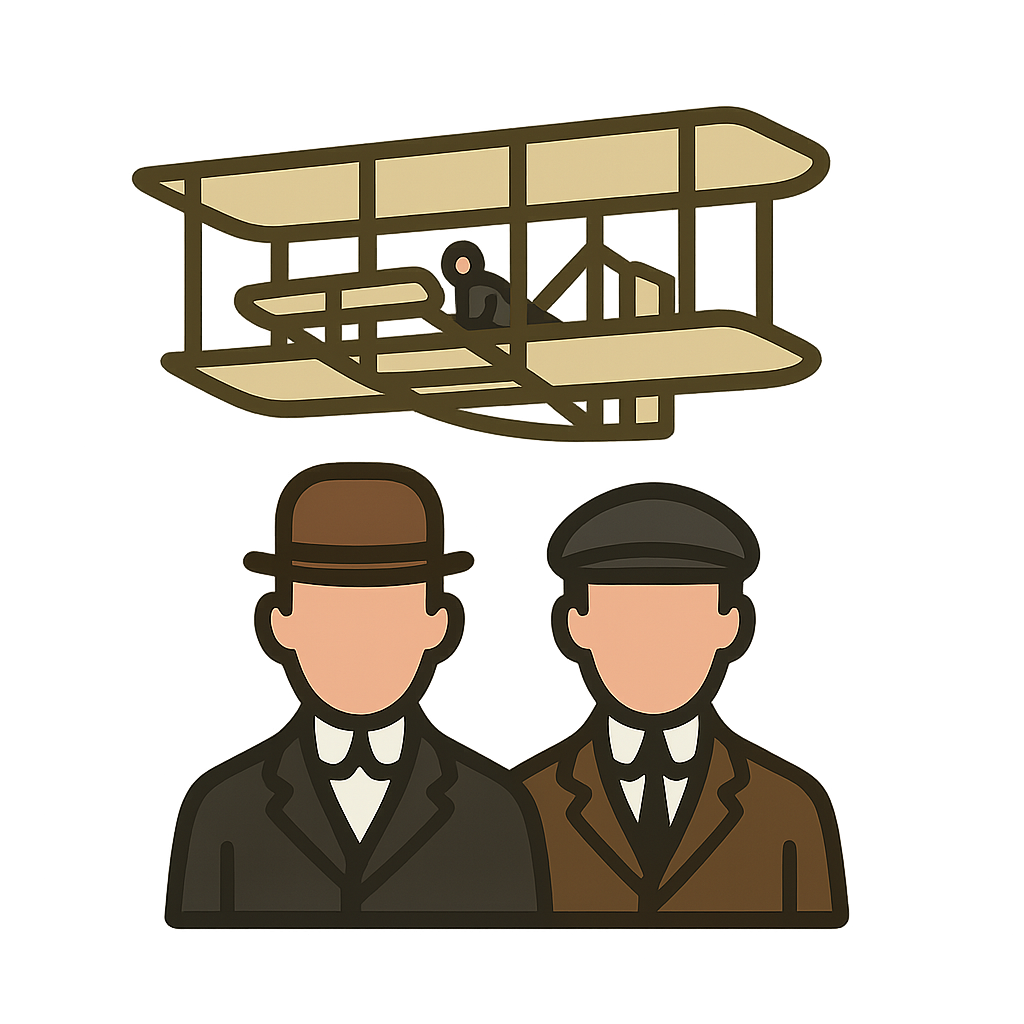
December 17, 1903, was a bitterly cold and windy day in Kitty Hawk. The wind whipped across the sand so hard it stung our faces, but we knew it was the wind we needed to help lift our Flyer. There were only five other people there to watch us, bundled up against the chill. Wilbur and I looked at each other. This was the moment we had worked toward our entire lives. Who would be the first to try? We tossed a coin, and I won. My heart was pounding in my chest as I lay flat on my stomach on the lower wing, my hands gripping the controls. The engine sputtered and coughed to life, roaring loudly over the sound of the wind. Wilbur steadied the wingtip as I released the restraining rope. The Flyer began to move down its wooden track, slowly at first, then faster and faster. I could feel every bump and rattle. And then, it happened. The ground just… fell away. I was flying! For twelve incredible seconds, I was no longer on the earth. The machine felt wobbly and uncertain, but it was flying under its own power. I soared for 120 feet before gently landing on the sand. It was the shortest flight you can imagine, but in those twelve seconds, Wilbur and I knew we had done it. We had made the impossible possible.
That first flight was just the beginning. After I landed, we took turns, and by the end of the day, we had made four flights in total. Wilbur made the last and longest flight of the day, staying in the air for almost a whole minute and covering 852 feet. We packed up our machine, tired but filled with a joy I can't even describe. We sent a telegram to our father back home that said, “Success. Four flights Thursday morning.” Looking back, I see that those first wobbly moments in the air opened up the entire sky. Our dream, which started with a simple toy, had become a reality through curiosity and never, ever giving up. And it proved that with enough determination, any dream can take wing.
Reading Comprehension Questions
Click to see answer