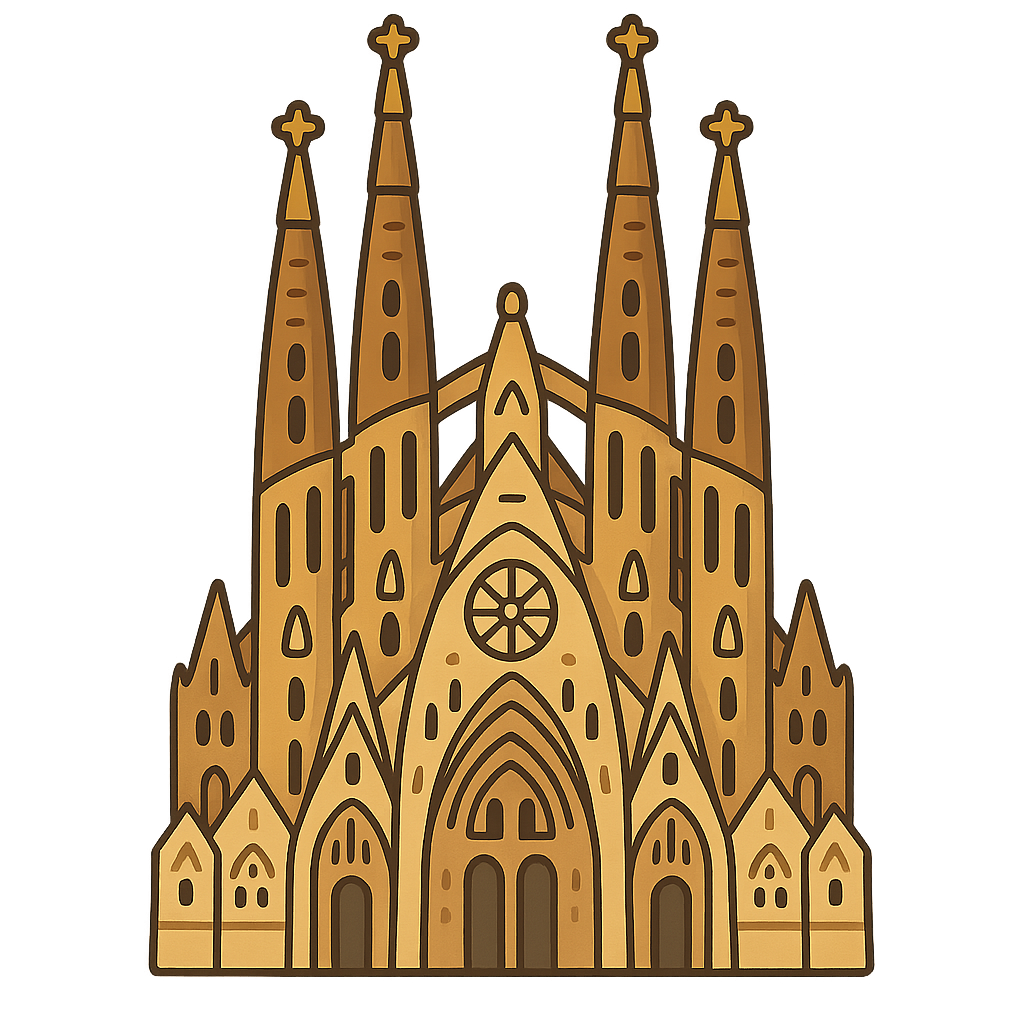
The Stone Forest's Dream
I rise from the heart of Barcelona, a city buzzing with life, my spires twisting toward the Spanish sky. To some, I look like a giant, fantastical sandcastle, dripping with details. To others, I am a forest made of stone, something that grew organically from the earth itself. My outer walls are a tapestry of stories, covered in carvings of turtles supporting my columns, chameleons hiding near my doors, and scenes from ancient tales. I am not like other buildings with their straight lines and sharp angles; I am all curves and life. When you step inside, the noise of the city fades away. You find yourself in a different world. Great columns soar upwards, branching out near the ceiling like the canopy of a colossal forest. The air itself is painted with light, as the sun pours through my thousands of stained-glass windows, splashing pools of sapphire, emerald, and ruby across the floor. I am a sanctuary of color and wonder, a puzzle of faith and nature. I am the Sagrada Familia, a church that is also a forest, a story, and a dream.
My story is inseparable from the man who dreamed me into being: the brilliant, unconventional architect Antoni Gaudí. Though construction on me began in 1882, it was when Gaudí took over the project in 1883 that my true soul began to take shape. He was a man who saw the divine in the details of the natural world. For him, nature was the ultimate architect, a great open book filled with perfect designs. He didn't just copy nature; he studied its engineering. He analyzed the way a tree branch supports its weight, how a flower petal curves, and how a snail’s shell spirals. He then translated these perfect, functional forms into my design. My branching columns are not just for beauty; they distribute my weight just as a tree does. Gaudí poured his entire being into my creation for over forty years, living in a small workshop on my grounds in his final years. He knew with absolute certainty that he would not live to see me completed. But this did not discourage him. Instead, he created intricate, detailed plaster models and architectural plans, leaving a clear and profound vision for the generations of builders who would follow in his footsteps.
I am not a silent building; my stone walls are designed to speak to everyone who sees them. Gaudí planned for me to have three grand entrances, or facades, each telling a crucial part of a larger story. The first, the Nativity facade, is the only one he lived to see nearly completed. It is an explosion of life and joy, celebrating the birth of Jesus. Every surface is covered with incredibly detailed sculptures of angels, shepherds, plants, and animals, all rendered with a lifelike, organic texture. It is a joyful welcome to the world. In stark contrast stands the Passion facade, which was built decades after Gaudí’s death. Its style is completely different: gaunt, angular figures are carved with sharp, severe lines. The artist, Josep Maria Subirachs, used this harsh, minimalist style to convey the pain and sacrifice of the story's final days. It is meant to be somber and thought-provoking. The final entrance, the Glory facade, is still under construction. When finished, it will be my main entrance, representing humanity's journey and final glory. Together, my three faces tell a complete story, from birth and joy to suffering and ultimate hope.
While my stone tells stories, it is the light inside me that gives me my spirit. Gaudí envisioned my interior as a space for peaceful contemplation, and he used color and light to create that atmosphere. My stained-glass windows are a masterpiece of artistic and scientific planning. They are not just a random collection of pretty colors. The windows on the east, which catch the morning sun, are filled with the cool hues of dawn: deep blues, vibrant greens, and soft lavenders. As the sun rises, it filters through these panes, bathing the interior in a light that feels fresh and new, like a forest waking up. On the opposite side, the windows facing the west are a symphony of warm colors: fiery oranges, brilliant yellows, and intense reds. As the sun sets, it ignites these windows, filling my halls with a warm, golden glow that feels like the end of a perfect day. This constant, shifting river of color ensures that the experience of being inside me is never the same twice. It is a living, breathing symphony of light designed to lift the human spirit.
Perhaps the most extraordinary thing about me is that my story is still being written. I have been under construction for more than 140 years, a project that has spanned generations. After Gaudí's death in 1926, work continued, paused by war and guided by his surviving models. In the modern era, architects use computer modeling and advanced stone-cutting technology to realize his vision with a precision he could have only dreamed of. Yet, the work is still done by the hands of dedicated craftspeople. I was consecrated as a basilica by Pope Benedict XVI in 2010, even while cranes still dotted my exterior. Millions of visitors from every corner of the globe walk through my doors each year, their entrance fees directly funding my continued construction. I am a living testament to the power of a shared vision. I am a reminder that the most beautiful and meaningful creations often require time, immense patience, and the collaborative effort of many hands. I connect the past, present, and future, showing the world how a single, brilliant idea can continue to grow and inspire for centuries to come.
Reading Comprehension Questions
Click to see answer