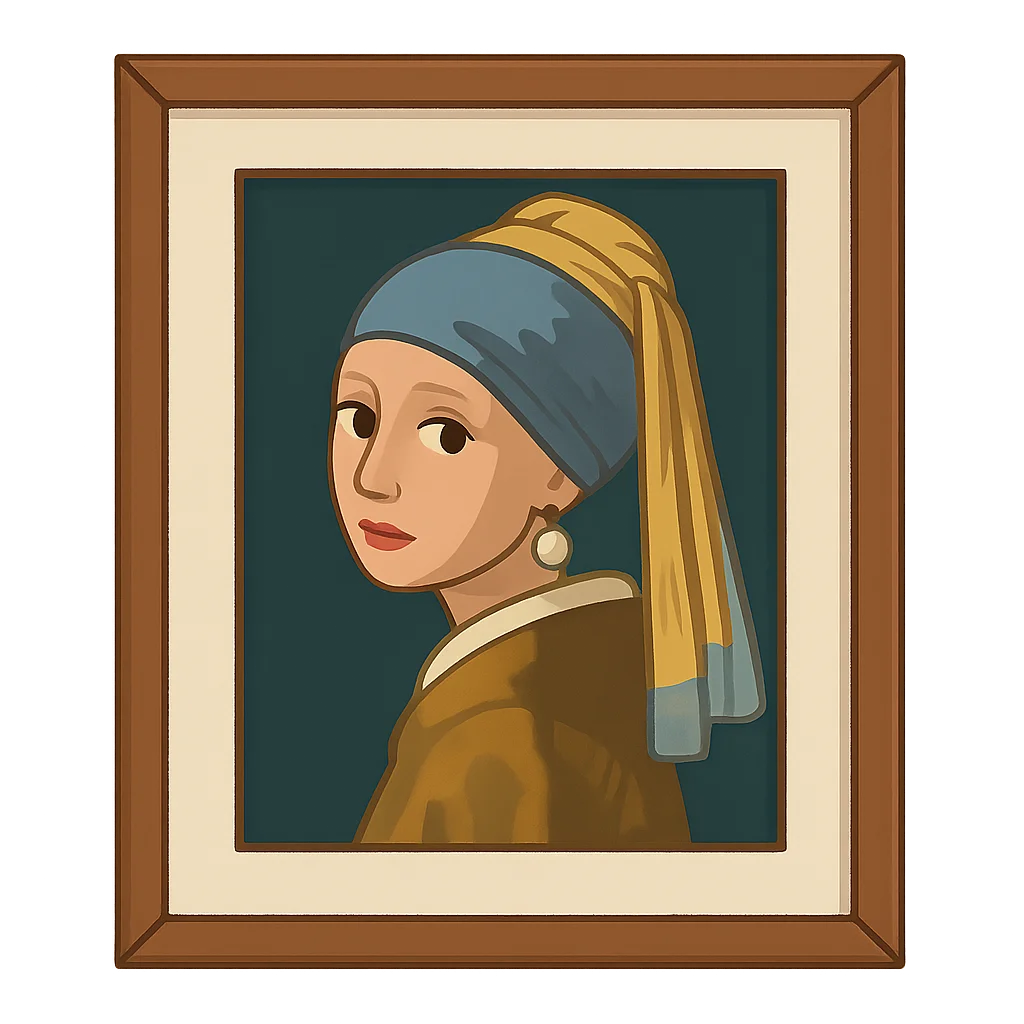
The Girl with a Pearl Earring
I float in a sea of darkness, but I am not lost. A soft light touches my face, making my skin glow and my eyes sparkle as I turn to look at you. Can you see the bright blue and yellow of the turban wrapped around my head? Or the single, shimmering pearl that dangles from my ear, catching the light like a tiny moon? For centuries, people have leaned in close, wondering who I am and what I am thinking. I am a quiet moment, a curious glance frozen in time. I am a painting, and they call me the Girl with a Pearl Earring. My story is one of a quiet artist, a long period of being forgotten, and a rediscovery that let my light shine for the whole world to see. I am more than just paint on a canvas; I am a question that has been waiting for your imagination for over three hundred years.
I was brought to life around the year 1665 in a cozy, light-filled studio in the city of Delft, in the Netherlands. My creator was a quiet master of light named Johannes Vermeer. He didn't paint grand battles or portraits of kings and queens; he loved to find the magic in everyday moments, like a woman reading a letter or a girl playing music. He wasn't trying to paint a specific person when he made me. Instead, he wanted to create what was called a tronie—a painting not of a person, but of a character or a feeling. Can you imagine painting a feeling like curiosity? That’s what he did. With his special brushes, he mixed oil paints to find the perfect shades for my skin and the bright yellow of my jacket. For my famous earring, he didn't paint every little detail. Instead, he used just a few clever dabs of thick white paint to make it look so round and real you could almost touch it. He captured the girl's expression just as she turned her head toward him, with her lips slightly parted, as if she was about to say something. That's his secret: he painted a question, not an answer.
After Vermeer finished painting me, my journey began. For almost two hundred years, I was a bit of a secret. I hung in different homes, my colors slowly dimming under layers of old, yellowed varnish. For a long time, people didn't even know that the great Johannes Vermeer had painted me. My story was almost lost forever. Then, on a day in the year 1881, a collector named Arnoldus des Tombe saw me at an auction in a city called The Hague. I was in rough shape, dark and cracked, but he saw something special in my gaze. He bought me for a very, very small price—about the cost of a picture frame today. It was a wonderful bit of luck. Later, a careful restorer cleaned me, and it was like a curtain being pulled back from a sunny window. My bright blue turban and my shining pearl glowed again. When Mr. des Tombe passed away, he generously donated me to the Mauritshuis museum in 1902, so that everyone could come and see me. That is where I have lived ever since, safe and admired.
Today, I hang on a quiet wall in my museum home, but my gaze travels all over the world. People come from every country just to look into my eyes and wonder. Who was this girl? What is she thinking? What was she about to say? I have inspired books, movies, and countless other works of art. The truth is, my mystery is my magic. I am a bridge that connects you to a moment that happened centuries ago. Though I was created in the 1600s, the girl’s simple, curious look reminds everyone that feelings of wonder and connection are timeless. I am a quiet whisper from the past, inviting you to imagine, to wonder, and to see the beauty that can be found in a single, fleeting moment.
Reading Comprehension Questions
Click to see answer