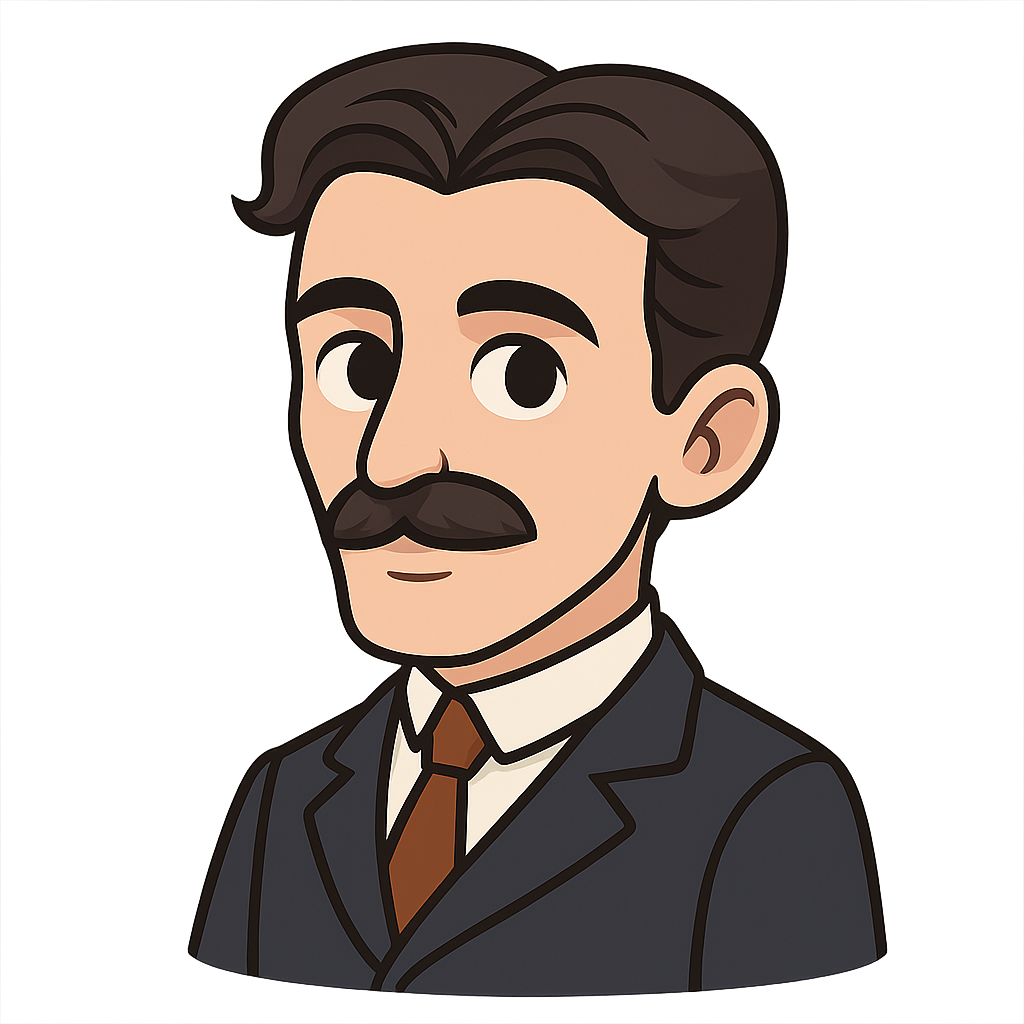
Nikola Tesla: The Man Who Lit the World
A Mind Full of Lightning
Hello. My name is Nikola Tesla, and I am an inventor. You may not know my name, but you certainly know my work. Every time you flip a light switch or charge a device, you are using the ideas that I brought to life. My story began on a very stormy night, on July 10, 1856, in a small village called Smiljan, which was then part of the Austrian Empire. Legend says that as I was born, lightning tore across the sky. The midwife, seeing this, declared it a bad omen, saying I would be a child of darkness. But my mother, Đuka, looked at the storm and said, “No. He will be a child of light.”
My mother was my greatest inspiration. Though she couldn’t read, she had the mind of an inventor, creating all sorts of tools to help with her work on our farm. She taught me to find joy in creating and to strengthen my memory. From her, I inherited a special gift: I could see inventions in my mind, complete and perfect down to the last detail. Before I ever built a machine, I would run it in my imagination for weeks, testing every part until I knew it would work. The powerful electrical storms that rolled through the mountains of my home weren't frightening to me; they were beautiful and full of mystery. I would watch the lightning crackle and wonder about the invisible force behind it. That powerful, untamed energy sparked my curiosity and set me on the path to dedicating my life to understanding and harnessing the power of electricity.
Crossing the Ocean for an Idea
My studies took me across Europe, from Austria to Prague, but my mind was always racing ahead of my teachers. I knew my most ambitious ideas needed a bigger stage, so in 1884, I set sail for America with only four cents in my pocket and a head full of dreams. I carried a letter of introduction to the most famous inventor of the age: Thomas Edison. His name was already legendary for the incandescent light bulb, and I was thrilled at the chance to work with him. At first, things went well. Mr. Edison hired me to improve the designs of his electrical generators, which ran on a system called direct current, or DC.
However, we soon discovered a deep disagreement between us. Mr. Edison's DC system was revolutionary, but it was inefficient. It couldn't travel long distances, meaning a power plant was needed on almost every city block. I had a better idea, a system I called alternating current, or AC. With AC, electricity could be sent powerfully and efficiently over hundreds of miles. I tried to explain the superiority of my vision, but Mr. Edison was stubborn and had invested everything in his DC technology. Our disagreement grew into a famous rivalry that people called the “War of the Currents.” It wasn't a war with weapons, but a war of ideas for how to power the future. I knew my AC system could change the world, providing more power to more people, more safely and cheaply. After a bitter dispute, I left his company, determined to prove that my vision was the correct one, even if it meant I had to start from nothing.
Harnessing Niagara and Dreaming Bigger
After leaving Edison, I faced difficult times, even having to dig ditches to earn money. But I never gave up on my AC motor. My luck changed when I met George Westinghouse, a brilliant engineer and businessman who saw the potential in my ideas. He believed in me and my AC system, and together, we set out to win the War of the Currents. Our greatest moment of triumph came in 1893 at the World's Columbian Exposition in Chicago. While Mr. Edison's DC system could only power a small exhibit, our AC system did something spectacular. We illuminated the entire fairground, turning night into day with hundreds of thousands of dazzling light bulbs. It was called the “City of Light,” and it showed the world, without a doubt, that AC was the future.
This victory led to the fulfillment of a dream I’d had since I was a boy. Back in my village, I saw a picture of the mighty Niagara Falls and told my uncle, “One day, I will harness that waterfall to make electricity.” In 1896, that incredible dream came true. My AC generators were installed at Niagara Falls, creating the world's first major hydroelectric power plant. For the first time, the immense power of nature was converted into electricity that traveled miles to power homes and factories in the city of Buffalo, New York. This achievement marked the end of the War of the Currents and the beginning of the modern electrical grid that powers our world today. During this time, I also invented many other things, including the Tesla coil, a device that could create spectacular bolts of man-made lightning and was essential for the future development of radio technology.
A Tower, a Vision, and a Legacy
Even after harnessing Niagara Falls, my mind was already leaping toward the next frontier. I dreamed of a world without wires. I envisioned a global system where information—and even energy itself—could be transmitted through the air to anyone, anywhere on Earth. My most ambitious project to bring this vision to life was a giant structure on Long Island, New York, called Wardenclyffe Tower. It was designed to be the first broadcast station of a worldwide wireless network. I believed it could send messages, pictures, and perhaps even electricity across oceans without a single cable.
Unfortunately, the world was not yet ready for such a radical idea. My financial backers grew nervous about a system that might deliver energy for free, and they pulled their funding. Wardenclyffe was never completed, and it remains one of my greatest disappointments. But I have learned that some ideas simply arrive before their time. My long journey came to an end in New York City in 1943, at the age of 86. I left this world with many patents to my name but very little money. My goal was never to be rich; it was to give my inventions to humanity. My true legacy is not just in the AC power that hums inside your walls, but in the spirit of tireless imagination. I hope my story reminds you to stay curious, to ask big questions, and to believe in the power of your own ideas. For it is the dreamers who build the future.
Reading Comprehension Questions
Click to see answer