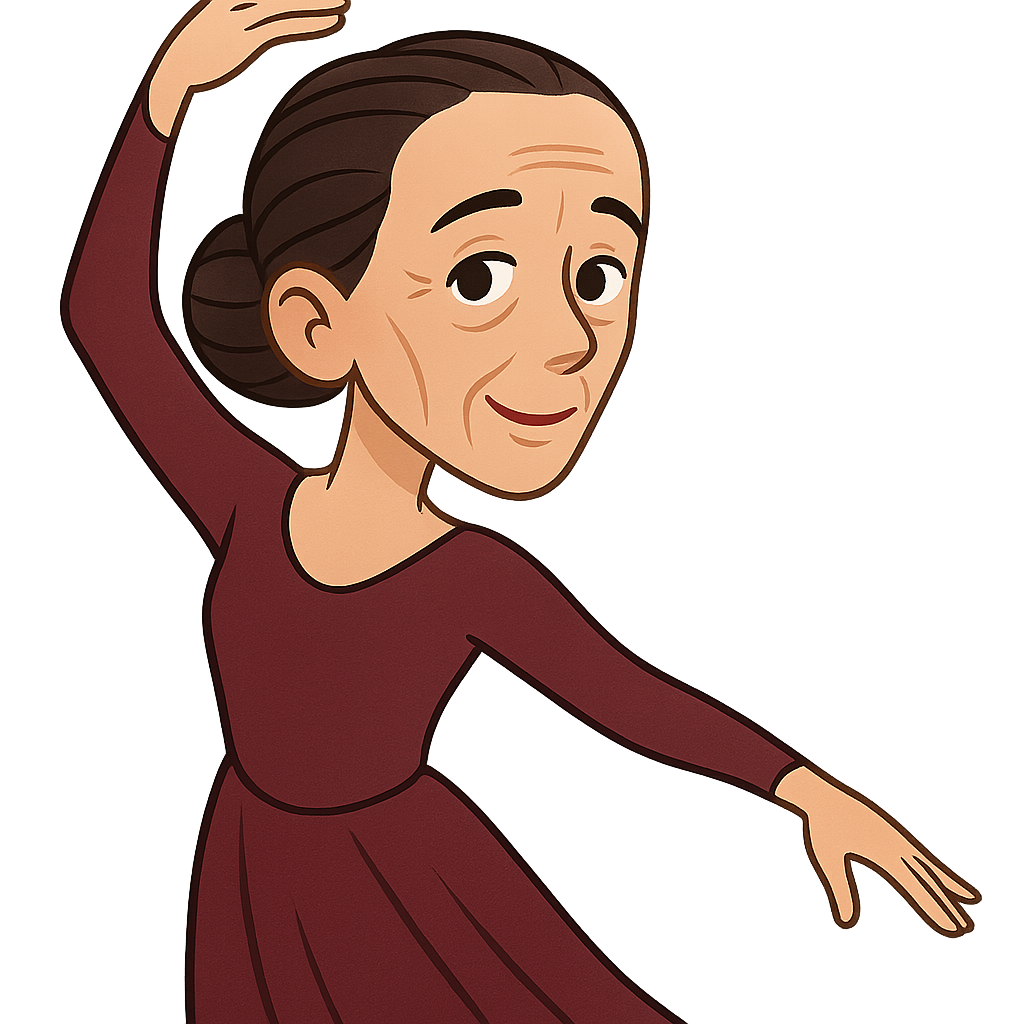
Martha Graham: A Life in Motion
Hello, my name is Martha Graham, and I spent my life learning to speak a secret language—the language of dance. My story begins not on a stage, but in a small town in Pennsylvania, where I was born in 1894. My father, George Graham, was a doctor who worked with people's minds. He taught me one of the most important lessons of my life. He would watch people very closely and once told me, “Martha, movement never lies.” He meant that the way a person holds their shoulders or walks across a room tells the true story of how they feel inside, even when their words don’t. I tucked that idea away in my heart, not yet knowing it would become the key to my future. One evening in 1911, when I was a teenager, my father took me to see a performance by a famous dancer named Ruth St. Denis. The moment she stepped onto the stage, the world changed for me. She moved like a character from an ancient myth, her costume shimmering under the lights. It wasn't just pretty; it was powerful. It was like a lightning bolt struck my heart. In that instant, I knew with absolute certainty that I was meant to be a dancer. The problem was, most dancers started when they were very young children. At seventeen, everyone thought I was far too old to begin. But the fire that Ruth St. Denis had lit inside me was too strong to ignore.
I was so determined that I finally convinced my family to let me attend a dance school. But as I learned the steps and poses, something felt wrong. I felt like I was just copying someone else’s movements, not discovering my own. My father’s words echoed in my mind: “movement never lies.” I wanted to create dances that told the truth about what it felt like to be human—the joy, the anger, the sadness, all of it. So, I made a scary decision. I left the school to find my own way to move. I spent years exploring how feelings live in the body. I discovered a new way of dancing that I called “contraction and release.” Think about what happens when you take a sudden, sharp breath. Your muscles pull in tight—that is a contraction. When you let the breath go, your body softens—that is a release. I realized this was the very rhythm of life, the physical source of every emotion. In 1926, I took a huge leap and started my own dance company in New York City. My friend, the musician Louis Horst, helped me create my first dances. They were not like the ballets people were used to. My movements were often sharp, angular, and close to the ground. In 1930, I created a solo called “Lamentation.” In it, I sat on a simple bench, wrapped in a tube of purple, stretchy fabric. I didn’t leap or twirl. Instead, I twisted and pulled against the fabric, showing the raw feeling of grief from the inside out. I wanted the audience to feel that sadness in their own bodies. I was creating a new language for the soul.
My journey as a dancer was long and full of purpose. I continued to perform on stage until I was 76 years old! Even when my body could no longer do the powerful falls and sharp contractions, my mind and spirit never stopped choreographing. I created more than 180 dances during my lifetime, and I was still creating new works right up until my life ended in 1991, when I was 96 years old. My ideas, which once seemed so strange and different, began to spread. I became a teacher, and many dancers who would become famous themselves came to my studio to learn my technique. My company traveled the world, sharing my vision of dance as a powerful form of expression. Looking back, I see that my father was right. Movement is a language that tells the truth. I believed the body was a sacred home for our feelings, and dance was the way to let those feelings speak. My greatest legacy is not just the steps I invented, but the idea that everyone has a dance inside of them. The next time you feel a powerful emotion, let your body respond. Let it tell its own true story. That is the dance that can change the world.
Reading Comprehension Questions
Click to see answer