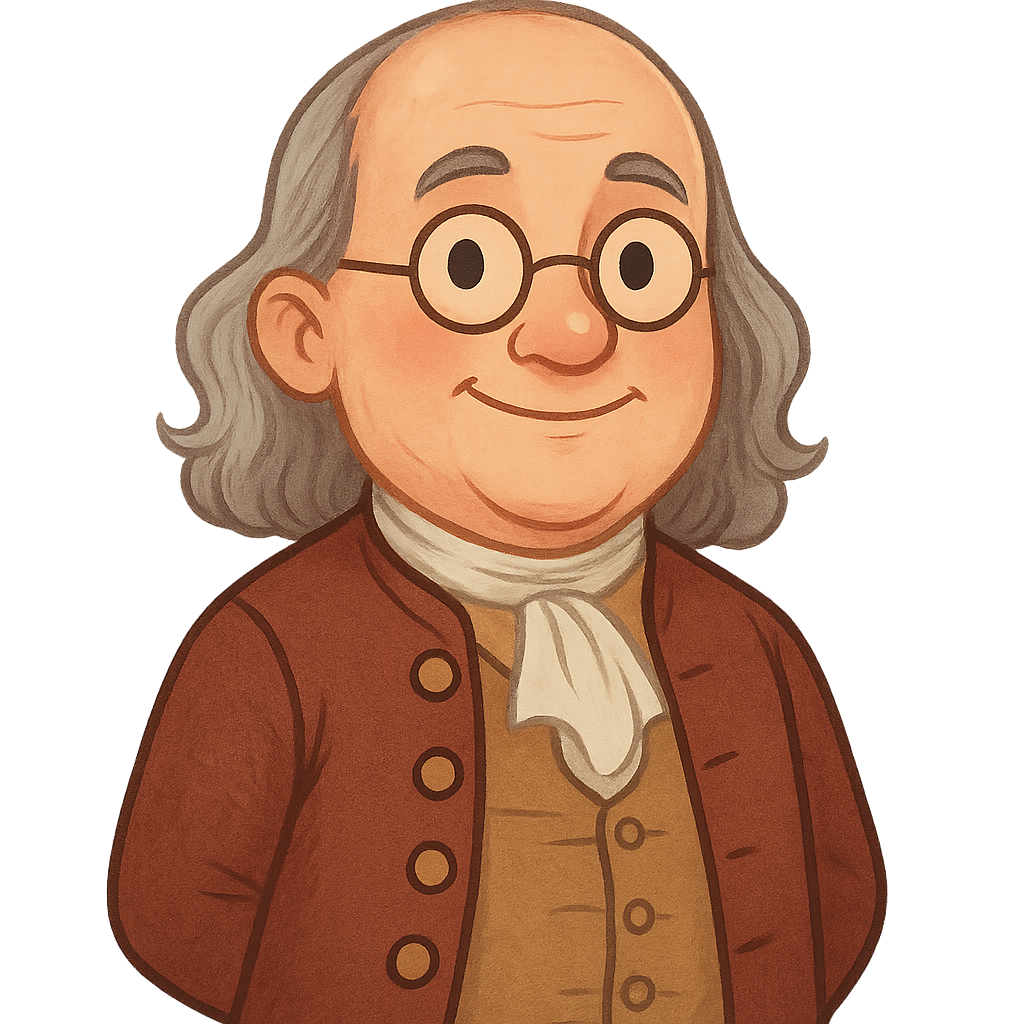
Benjamin Franklin
My name is Benjamin Franklin, and I was born in the bustling colonial city of Boston, Massachusetts, on January 17, 1706. My life was an adventure filled with curiosity, invention, and the exciting birth of a new nation. I was the fifteenth of seventeen children, so our house was always noisy and full of life. My father was a candlemaker, and while I loved him dearly, I knew that dipping wicks into hot wax was not the future for me. My true passion was for books. I would save every penny I could to buy them and read them late into the night. My formal schooling was brief, lasting only two years, as my family could not afford more. At the age of twelve, I was sent to work as an apprentice in the printing shop of my older brother, James. While I learned the trade of printing, I yearned to share my own ideas. Knowing my brother would never publish the writings of his younger sibling, I created a secret identity: a witty widow named Silence Dogood. I would slip letters under the print shop door at night, and to my delight, James published them in his newspaper, the New-England Courant. They became incredibly popular! But keeping my secret while working under my brother’s strict rules became difficult. I felt a growing desire for independence, and in 1723, at the age of seventeen, I made the bold decision to run away and start a new life in a city called Philadelphia.
I arrived in Philadelphia, Pennsylvania, a tired and hungry young man with only a few Dutch dollars and copper shillings in my pocket. I remember walking down Market Street, clutching three puffy bread rolls—one under each arm and one I was eating. It was a humble beginning, but my mind was brimming with ambition. I was determined to make my own way. I found work as a printer and, through hard work and a reputation for being reliable, I was able to open my own printing shop by 1728. Soon after, I purchased a newspaper and renamed it the Pennsylvania Gazette, which became one of the most successful papers in the colonies. In 1732, I began publishing another project that would bring me great fame, Poor Richard's Almanack. It was an annual pamphlet filled with weather forecasts, puzzles, and wise, witty sayings like, "A penny saved is a penny earned." But my interests went beyond just my business. I loved Philadelphia and wanted to make it a better place for everyone. I gathered a group of friends, which we called the Junto, to discuss ideas for community improvement. From these discussions, we started the first subscription library in America in 1731, allowing people to borrow books they couldn't afford to buy. We also organized the Union Fire Company in 1736, the city's first volunteer fire department, and I later played a key role in founding the academy that would become the University of Pennsylvania.
As my printing business thrived, I found I had more time to pursue another one of my great passions: science. I was fascinated by the natural world and loved conducting experiments to understand how things worked. My biggest curiosity was the powerful and mysterious force of lightning. Many people in my time believed it was a supernatural act of anger from the heavens, but I suspected it was a form of electricity, something I had been studying for years. To prove my theory, I planned a daring experiment. On a stormy June day in 1752, I took my son, William, to a field and we flew a kite with a metal key tied to the string. As the storm clouds gathered, I noticed the loose threads of the kite string standing on end. I cautiously brought my knuckle close to the key and—zap!—a spark jumped to my hand. It was a thrilling, and slightly frightening, moment. I had proven that lightning was indeed electricity! This discovery was not just for show; I wanted it to be useful. I used this knowledge to invent the lightning rod, a metal conductor that could be placed on top of buildings to safely guide electrical charges from lightning strikes into the ground, preventing fires. My desire to solve everyday problems also led me to create other inventions, like bifocal glasses so I could read and see at a distance without changing spectacles, and the Franklin stove, a more efficient metal-lined fireplace that produced more heat with less smoke.
My life took another turn as the American colonies began to feel the heavy hand of British rule. I found myself drawn into the world of politics, using my voice and mind to argue for our rights. I spent many years in London representing the colonies, trying to find a peaceful solution, but the relationship with Great Britain grew more and more strained. When it became clear that our freedom was on the line, I returned home to Philadelphia. In the summer of 1776, I had the great honor of sitting in a room with brilliant men like Thomas Jefferson and John Adams to help draft one of the most important documents in history: the Declaration of Independence. I was the oldest signer, and I knew we were risking everything for the dream of a new nation. During the Revolutionary War that followed, our young country needed help, so I sailed to France as a diplomat. My job was to persuade the French king to become our ally. It was a difficult task, but in 1778, we succeeded, and France's support was crucial to our victory. I returned home in 1785 to a hero's welcome. Even in my old age, my work was not done. In 1787, I attended the Constitutional Convention, where I helped shape the government of the United States. I watched with immense pride as a new republic was born, a nation founded on the principles of liberty I had championed my entire life. On April 17, 1790, my long and eventful life came to an end. I had lived to see a dream become a reality, and I hoped my journey from a runaway apprentice to a founding father would inspire others to live with curiosity, work hard, and always strive to improve the world around them.
Reading Comprehension Questions
Click to see answer